PPC Advertising Strategy: Complete Guide to Google Ads, Facebook Ads & ROI
You’re running a contracting business. You need customers. Google Ads shows up in your face saying “We’ll get you leads.” Facebook ads promise the same thing. You’re tempted. But here’s what stops you: you don’t know if it actually works. You hear horror stories about contractors spending thousands and getting nothing. You don’t want to be that person.
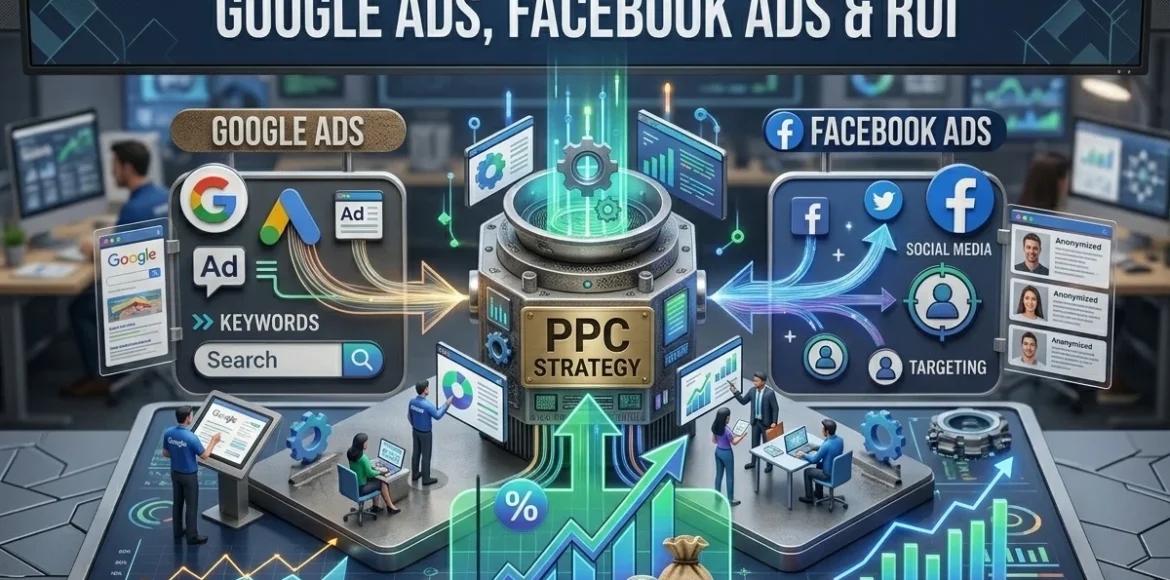
Here’s the truth: PPC advertising strategy works. But it only works if you do it right. Most contractors fail because they don’t understand the system. They throw money at ads hoping something sticks. That’s not strategy. That’s gambling. Real pay per click advertising is simple once you understand it. This guide walks you through everything. How Google Ads strategy actually works. How Facebook ads work differently. How to manage ad campaign management properly. Real ROI numbers. Real mistakes to avoid. By the end, you’ll know exactly how to run profitable paid search marketing campaigns.
Why PPC Advertising Actually Matters for Service Businesses
Service businesses (like contracting, countertops, remodeling) have a huge advantage online. People actively search for you. Someone needs countertops. They search for “countertop installation near me” or “granite countertops in [city].” That’s pay per click advertising at its best. They’re already looking. You just need to show up.
Traditional advertising is inefficient for service businesses. Radio ads reach thousands who don’t need you. Direct mail hits neighborhoods where most people aren’t looking. PPC advertising strategy only pays when someone actually clicks your ad. That’s the difference. You’re not paying for eyeballs. You’re paying for interesting clicks. That efficiency is everything.
ROI potential is massive. Spend $1,000 on Google Ads. Get $5,000 in revenue from those leads. That’s real. That happens constantly. It only works if your strategy is sound. But when it works, it scales. More ad spend = more qualified leads = more revenue. That’s the power of PPC advertising for service businesses.
Speed matters too. SEO takes months to work. Paid search marketing works tomorrow. You need customers next week? Ads get you there. Do you need customers next month? Ads scale to that. Need customers next quarter? Ads are already working. That speed is why contractors lean on PPC advertising strategy.
What PPC Actually Means (And Why It Matters)
PPC stands for Pay-Per-Click. You write an ad. It shows in Google or Facebook. Someone clicks it. You pay. That’s the basic model.
You don’t pay if someone sees your ad and ignores it. You don’t pay for impressions (views). You only pay when someone actually clicks. That’s the defining feature of pay per click advertising. It’s different from traditional advertising where you pay whether anyone notices or not.
Cost varies by platform and competition. Google Ads strategy in competitive markets costs $2-$10 per click for service businesses. Less competitive markets might be $0.50-$2 per click. Facebook ads typically cost $0.50-$3 per click for contractors. These are averages. Your actual costs depend on competition, quality, and targeting.
The math is simple. If a click costs $5 and you close 10% of clicks into customers, your customer acquisition cost is $50. If each customer spends $3,000, your ROI is 6000%. That’s why contractors use PPC advertising. The numbers work when strategy is right.
Google Ads Strategy: How Search Advertising Actually Works
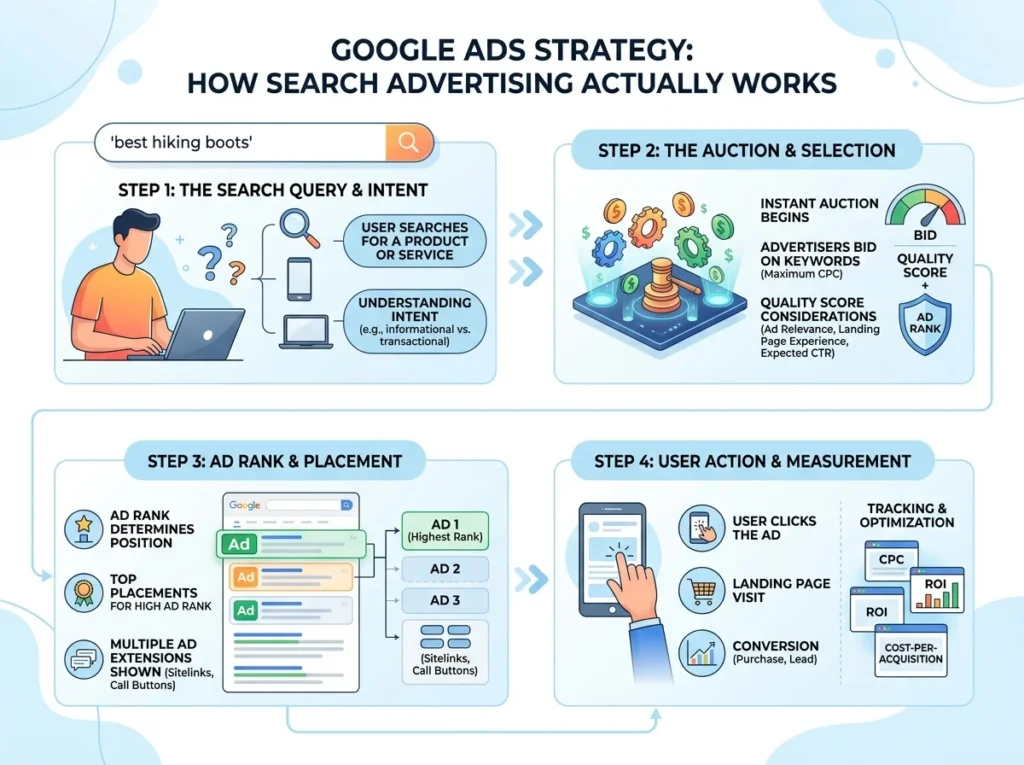
Google Ads is the big one. Most service business revenue comes from Google. Here’s why. Someone searches “countertops near me.” Google shows your ad. They click. They call. That’s a hot lead. They were actively searching.
Google Ads strategy starts with keywords. You choose words people search. “Granite countertops Ohio.” “Kitchen remodel near me.” “Countertop installation.” Google shows your ads when people search these words. You only pay when they click.
Quality matters hugely. Google doesn’t just show the highest bidder. They show ads that are relevant. Ads that match what people searched. Ads that have good click-through rates. If your ad is irrelevant, Google charges you more. If your ad is great, Google charges you less. This is why Google Ads strategy includes writing good ad copy.
The landing page is critical. Someone clicks your ad. Where do they land? Homepage? That’s weak. Specific page about that service? That’s strong. If someone searched “granite countertops,” they should land on your granite countertops page. Not your homepage. This relevance affects both Google’s pricing and your conversion rate.
Bidding strategy determines your costs. You can bid high to dominate. Or bid low to test. Most contractors start low, learn what works, then increase bids. Paid search marketing is flexible. You control spending.
Facebook Ads Strategy: Understanding Social Paid Advertising
Facebook ads work differently. Google shows ads to people actively searching. Facebook shows ads to people scrolling socially. Different intentions. Different strategies needed.
Facebook ads work through targeting. You tell Facebook who you want to reach. Age, location, interests, behaviors. Facebook shows your ads to those people. You’re reaching people before they’re searching. You’re getting in front of them early.
This is better for awareness and nurturing. Someone sees your gorgeous bathroom renovation on Facebook. They’re not searching yet. But they see it. They save it. Months later when they need countertops, they remember your ad. That’s the Facebook value. Top-of-funnel brand awareness.
Cost is typically lower than Google. Facebook ads for service businesses often cost $0.50-$3 per click. Cheaper than Google. But conversion rates might be lower (cold traffic versus hot search traffic). That’s the tradeoff. You spend less per click but might need more clicks to get customers.
Video ads on Facebook convert well. Show before-and-after transformations. Show actual work. People engage with video. If your ad campaign management includes video, engagement improves.
Retargeting on Facebook is powerful. Someone visits your website but doesn’t call. You can show them ads on Facebook reminding them. That nurturing brings people back.
Building Your PPC Advertising Strategy: Foundation First
Before launching ads, get the foundation right. This is where most contractors fail. They skip this and wonder why ads don’t work.
Your website needs to be ready. Ads drive traffic to your website. If your website is slow, ugly, or doesn’t explain your services, traffic doesn’t convert. Fix your website first. Then add ads.

Your phone number needs to be obvious. Easy to call. People should see it immediately. If it takes three clicks to find your phone number, you lose leads. Make it prominent.
Your past work needs to be visible. Photos of completed projects. Before-and-afters especially. People want proof you do good work. Gallery matters for service businesses.
Your service area needs to be clear. Ads target local areas. Your website should match. If you serve Columbus, say that clearly. If you serve surrounding suburbs, list them.
Your pricing should be roughly estimated. You don’t need exact quotes online. But rough pricing helps. “Kitchen countertops installation: $3,000-$8,000” helps people self-qualify. Without it, everyone clicks (even people with $500 budgets).
Google Ads Strategy Deep Dive: Keyword Selection & Management
Keywords are everything in Google Ads strategy. You choose keywords. Google shows your ads when people search those keywords.
Start with high-intent keywords. “Kitchen countertop installation.” “Granite countertops near me.” “Countertop replacement.” These are people actively searching for solutions. They convert best.
Add location keywords. “Columbus countertops.” “Countertops in Dublin, Ohio.” “Kitchen remodel near Worthington.” Local intent keywords get searched frequently in service businesses.
Long-tail keywords are underrated. “Custom granite kitchen countertops Columbus Ohio” has fewer searches but higher intent. Someone searching that exact phrase is ready. They know what they want.
Avoid super broad keywords. “Countertops” gets millions of searches. But most are people just researching. Not searching for your local services. Too expensive. Too many wasted clicks.
Match types matter. Exact match shows ads only for that exact search. Phrase match shows for that phrase and variations. Broad match shows for related searches. Start with exact and phrase matches. They’re more targeted. Less wasted spend.
Negative keywords prevent wasted spend. Block “cheap,” “DIY,” “free quotes.” Block keywords that don’t match your service. If someone searches “countertop prices” they might just be researching. Add it as a negative keyword so your ad doesn’t show.
Ad Campaign Management: Structure & Organization
Managing ads gets complex fast. Good structure prevents chaos.
Create separate campaigns for different services. Kitchen countertops campaign. Bathroom vanities campaign. Backsplash installation campaign. Separate budgets. Separate keywords. Separate ads.
Create separate ad groups within campaigns. Kitchen campaigns might have ad groups for “Granite Kitchen,” “Quartz Kitchen,” “Kitchen Installation.” Each has relevant keywords and relevant ads. Tight organization means better quality scores and lower costs.
Write multiple ad variations. Test different headlines. Different descriptions. Different calls-to-action. Let ads run. See which performs best. Double down on winners.
Use ad extensions. Call extension (click to call). Location extension (shows your location). Sitelink extensions (link to specific pages). These make ads bigger. More noticeable. Better click-through rates.
Test landing pages. Send some traffic to your general countertops page. Send some to a specific service page. See which converts better. Then shift the budget to the winner.
Pay Per Click Advertising Economics: Understanding ROI
Here’s where it gets real. Numbers matter. You need profitable campaigns.
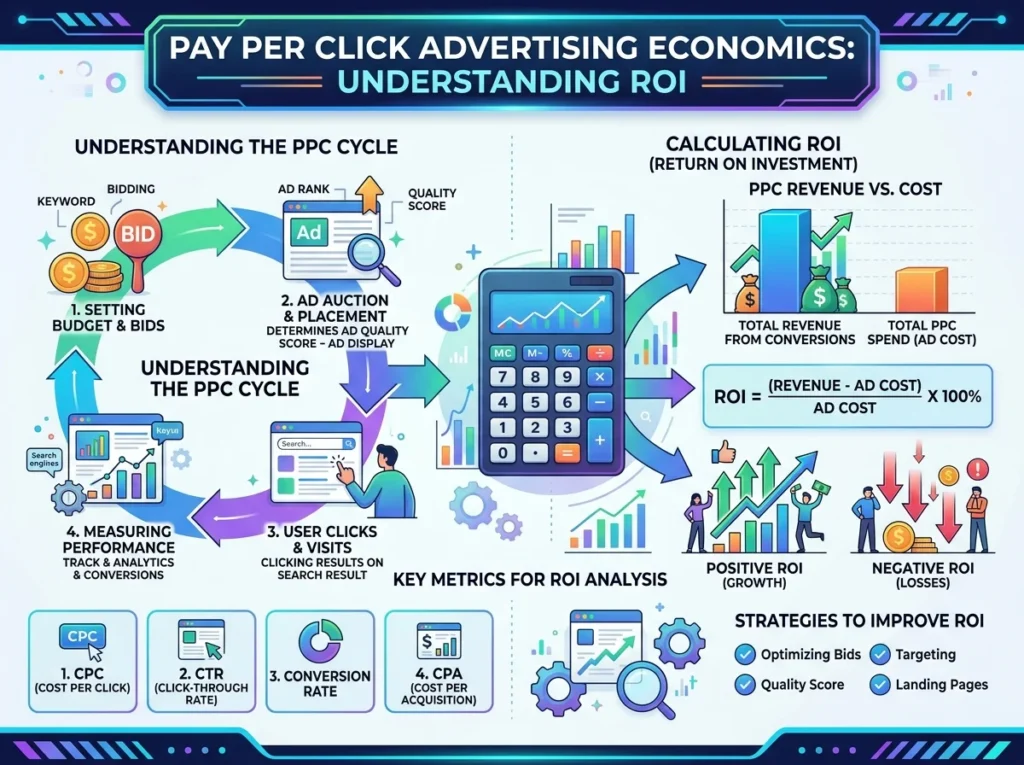
Track everything. Which keywords convert. Which converts cheaply. Which is a waste money. Can’t improve what you don’t measure.
Calculate customer acquisition cost (CAC). Total ad spend divided by customers acquired. If you spend $1,000 and get 5 customers, your CAC is $200. If each customer spends $3,000, your profit margin improves dramatically.
Compared to lifetime value. How much does the average customer spend total? Include repeat business. If customers spend $3,000 on average, CAC of $200 is fantastic. If customers spend $500 on average, CAC of $200 is bad.
Set profitability targets. Decide acceptable CAC. Maybe $300 is maximum. If keywords cost more than that, pause them. Discipline with budget is everything.
Scale winners. If keywords are getting leads at $200 CAC, increase budget. More budget = more leads = more revenue. Growth is reinvesting winners.
Pause losers. If keywords cost $500 per lead and profit per lead is $200, you lose money. Pause immediately. Redirect budget to winners.
Facebook Ads vs Google Ads: Which Should You Use?
Both can work. Depends on your situation.
Use Google Ads if: You want immediate leads from people actively searching. You need quick ROI. You’re comfortable with higher per-click costs. You want to dominate searches in your area.
Use Facebook Ads if: You want awareness before people search. You want video engagement. You want lower per-click costs. You’re building long-term brand presence.
Use both if: You have a budget for both. Google gets hot leads now. Facebook builds future leads. Together they’re powerful.
Most contractors start with Google. Better ROI in early days. Then add Facebook after success.
Common PPC Advertising Mistakes (And How to Avoid Them)
Most contractors make predictable mistakes. Knowing them prevents expensive learning.
Mistake 1: No tracking. They run ads but don’t track results. Can’t optimize. Can’t scale. Install conversion tracking immediately.
Mistake 2: Too broad targeting. They target everyone. Ads cost too much. Conversions are low. Narrow targeting. Spend more money per click but get better returns.
Mistake 3: Bad landing pages. Ads drive traffic to the homepage. The homepage doesn’t explain their specific service. People bounce. Ads seem ineffective. Create specific landing pages for specific ads.
Mistake 4: Ignoring quality scores. Low-quality ads pay more. High-quality ads pay less. Write good ads. Create relevant landing pages. Quality scores improve. Costs drop.
Mistake 5: Not testing. They set ads and forget them. Ads degrade over time. Competition increases. Costs rise. Test continuously. Try new keywords. Try new ads. Keep improving.
Mistake 6: Giving up too fast. They run ads for two weeks, see no results, quit. Ads need time. Algorithms need data. Give campaigns 4-6 weeks minimum. Then optimize based on actual data.
Mistake 7: Not scaling winners. They find profitable keywords but don’t increase the budget. Scared of losing money. Missed opportunity. Scale winners. Growth comes from doubling down on what works.
Paid Search Marketing for Seasonal Businesses
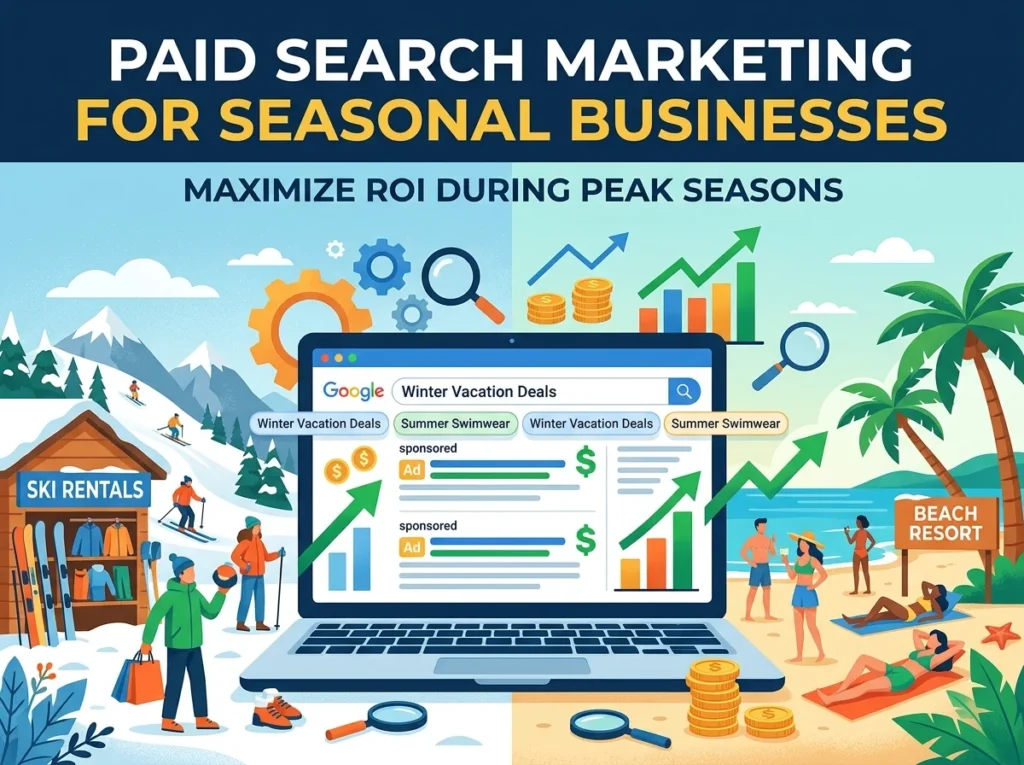
Countertop work is somewhat seasonal. Busier in spring and summer. Slower in winter.
Adjust budgets seasonally. Increase budgets April-August when demand is high. Decrease budgets December-February when demand is low.
During the busy season, raise bids. More budget available. More competition. Higher bids get placements. During the slow season, lower bids. Conserve budget. Get strategic placements only.
Plan campaigns around seasonality. Summer campaigns emphasize kitchen renovations (busy season). Winter campaigns emphasize small upgrades or indoor projects.
FAQ About PPC Advertising Strategy
How much should I spend on PPC advertising?
Start with $500-$1,000 monthly. Test market. See what works. If ROI is positive after 4-6 weeks, increase the budget. If ROI is negative, troubleshoot before increasing. The budget should scale with profitability. Profitable campaigns can grow to $5,000+ monthly.
How long before I see results from Google Ads?
Ads go live immediately. You’ll see clicks within hours. But meaningful data takes time. Give campaigns 2-4 weeks to accumulate data. 4-6 weeks to understand patterns. Full optimization takes 8-12 weeks. Patience is critical. Don’t judge campaigns by first week.
What’s a good conversion rate for service business ads?
1-3% is typical. You get 100 clicks, 1-3 become customers. Varies by service and quality. Excellent conversion rates are 3-5%. Poor conversion is under 1%. If you’re under 1%, optimize landing pages or ad targeting.
Should I use Google Ads or Facebook Ads?
Both work but differently. Google targets people actively searching (hot leads). Facebook targets awareness (cold traffic). Start with Google. Add Facebook after Google success. Together they’re powerful.
How do I know if my PPC is profitable?
Track customer acquisition cost. Calculate how much each customer spends. If customer value is 3x or more than acquisition cost, you’re profitable. Example: $200 acquisition cost, $600+ customer value = profitable.
What’s the difference between search and display ads?
Search ads appear when people search keywords (Google.com). Display ads appear on websites people visit. Search is higher intent (people actively searching). Display is lower intent (people browsing). Search converts better. The display costs less.
Can I manage PPC myself or should I hire an agency?
You can manage if you’re detail-oriented and patient. The learning curve is 2-3 months. If you value your time, hire an agency. Agency costs $500-$2,000 monthly. If they generate $5,000+ in monthly value, they pay for themselves.