
Launching a mobile app is a major milestone, but it is not the end of the development process. As actual users download, use, and review the application, new issues may emerge not observed during the tests. Operating systems change, security risks evolve, third-party services update, and user expectations continue to rise.
For this reason, it is crucial to consider mobile app maintenance costs from the start. Professional mobile app development and ongoing application costs can be very variable depending on the complexity of the app, the development team, host requirements, and the frequency of updates to the app for Anaheim and Orange County businesses.
A rule of thumb is that maintenance costs are approximately 15-25% of the development costs annually. For instance, a $100,000 app may need around $15k – $25k of maintenance costs per year following the initial stabilisation period.
Your App’s Real Journey Starts After Launch
An app may start up without a problem, but require urgent attention after the start-up. The way real users use mobile apps is very different from the way internal testers do. They can take older versions of software, flaky internet connections, unsuspecting workflows, or mixtures of features that reveal bugs. User feedback will also help identify issues with navigation, load times, and usability of features that are technically working but not working for the user.
Post-launch maintenance typically includes:
- Bug fixes and corrective maintenance
- Security patches and security updates
- App performance monitoring
- OS update compatibility
- App Store and Google Play policy updates
- Backend and server maintenance
- Third-party API updates
- Small feature improvements based on user feedback
Without ongoing maintenance, even a well-built app can gradually become slower, less secure, or incompatible with newer devices.
What Does Mobile App Maintenance Actually Cost?
The monthly price does not exist as there are huge differences in the needs of the maintenance of a simple business app and an e-commerce, marketplace, or app with thousands of active users.
A useful starting point, especially when reviewing our mobile app development cost breakdown, is to look at the app’s original development investment.
| Original App Cost | Estimated Annual Maintenance | Approximate Monthly Budget |
| $30,000 | 4,500–7,500 | 375–625 |
| $50,000 | 7,500–12,500 | 625–1,040 |
| $100,000 | 15,000–25,000 | 1,250–2,085 |
| $200,000 | 30,000–50,000 | 2,500–4,170 |
These are planning estimates rather than fixed prices. The industry standard estimate for the steady-state cost of app maintenance is around 15% to 25% of the cost of building the app. It can also be a bit more expensive in the first year as the team is getting the app ready for the real world and preparing for platform changes.
Why Anaheim and Orange County Businesses May See Different Costs

Pricing for local development may impact the expenses of supporting the app after it has been released.
Some companies in Orange County have app and software development rates of 50-99 dollars an hour and 150-199 dollars an hour. While not all Anaheim businesses will be charged those rates, it’s an example of how the same job can cost more or less with a local agency, a distributed team, or an offshore provider.
For comparison, other app marketplace development data reveals that many development companies are pricing at approximately 25–49 per hour, with variance depending on location, expertise, and the complexity of the project. The goal should not simply be to find the lowest hourly rate. A cheaper team that needs extensive time to understand an unfamiliar codebase can become more expensive than a knowledgeable partner with a higher rate.
The Main Costs After Your App Goes Live
Bug Fixes and Performance Issues
None of the testing processes can detect all possible issues. After hundreds or thousands of users start using an application, developers might find crashes, broken forms, login issues, a slow interface, or problems with specific devices. Some minor bug fixes can take hours. Larger issues that relate to the back end, payment system, or database may take much longer to work on.
By monitoring the app’s performance regularly, issues can be spotted early, before they become common complaints by users.
Operating System and Device Compatibility
Apple and Android are constantly bringing new operating systems, SDKs, and device models to the market. An application that functioned well the previous year might need to be updated for compatibility with the new software and hardware. This work can include updating libraries, adjusting permissions, replacing deprecated code, and testing the application on newer devices.
The updates for OS compatibility are typically not optional when the business needs to keep issuing them and have a consistent user experience.
Security Updates
Security Patches will be a guard for the business and its users. This may include dependency updates, vulnerability patching, authentication enhancements, or plugging third-party weaknesses. Some apps have a higher security budget than others, such as payment processing apps, which collect personal information, or business apps that store sensitive data.
Skipping security updates because of cost could lead to far greater costs in the future.
Hosting, APIs, and Other Ongoing Expenses
Not every cost comes from developer hours. Many mobile apps depend on external services.
Common recurring expenses include:
| Cost Category | What It May Cover |
| Cloud hosting | Servers, databases, storage, and traffic |
| Third-party APIs | Maps, payments, messaging, AI, or other integrations |
| Monitoring tools | Crash reporting and performance tracking |
| App store accounts | Developer program fees |
| Security services | Monitoring, audits, and vulnerability management |
The cost of hosting depends on the application’s complexity and traffic and can vary from a few dollars a month for a simple application to thousands of dollars a month for high-traffic, complex ones. The cost of basic cloud infrastructure could range from $50 to $200 per month, depending on the estimate, and high-traffic sites could cost $2,000 to $10,000 or more.
Post-Launch Support Is Not the Same as New Feature Development

This is a crucial consideration when you are comparing app update maintenance plans. A maintenance retainer typically includes maintenance functions to ensure the stability, security, compatibility, and usability of the existing application. This can involve bug fixes, security fixes, compatibility, and monitoring updates.
A major new feature is typically a standalone project for development. For instance, a broken checkout button could be considered an ongoing app support issue. Creating a completely new loyalty program, AI assistant, or marketplace feature might need more planning, design, building, and testing.
Businesses should inquire about their monthly/annual maintenance bill and what will not be covered prior to signing a maintenance contract.
How Often Should a Mobile App Be Updated?
There is no universal schedule. Updates should be based on technical needs and user priorities rather than publishing changes simply to appear active.
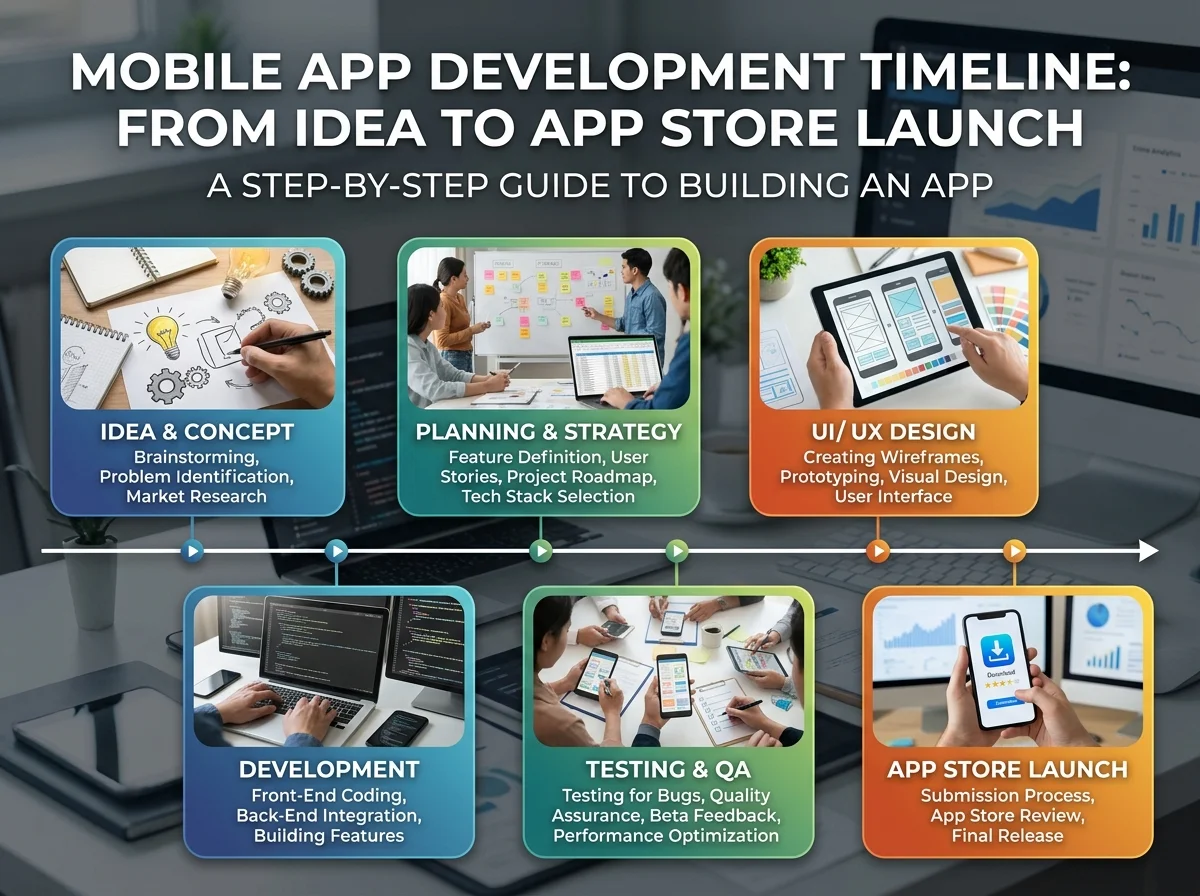
A practical maintenance approach, similar to planning milestones outlined in our mobile app development timeline, may look like this:
- Continuous monitoring: Watch crashes, load times, and critical errors.
- Security updates: Address important vulnerabilities as soon as reasonably possible.
- Monthly or quarterly reviews: Review bug reports, user feedback, and performance data.
- OS compatibility testing: Prepare for major iOS and Android changes.
- Planned feature releases: Schedule improvements based on business priorities and user demand.
Many actively maintained apps are updated approximately every 4 to 6 weeks—how often is right for an app depends on the app and its users.
How to Build a Realistic Maintenance Budget
The easiest mistake is treating maintenance as an unexpected expense after launch. But, for businesses in Anaheim and Orange County, it is best to make a budget for post-launch activities and divide it into three components:
1. Essential Maintenance
This includes bug fixes, security updates, OS support, and important infrastructure updates. These costs keep the existing app functional.
2. Performance and Improvements
This budget will include app performance optimizations, user experience tweaks, and some smaller changes based on analytics and feedback.
3. Future Growth
For new features, integrations, and significant redesigns, there should be a specific budget allocated. This allows the maintenance retainer to be protected from expansion work.
Businesses working with All 4 One Local can also benefit from discussing this separation before launch, so the initial development plan and long-term support expectations are aligned.
How to Keep Mobile App Maintenance Costs Under Control
Reducing maintenance costs does not mean ignoring updates. It means preventing unnecessary work.
A few practical strategies include:
- Keep the codebase organized and documented.
- Remove unused features and outdated dependencies.
- Monitor crashes before they affect large numbers of users.
- Test OS compatibility before major releases.
- Prioritize fixes based on business and user impact.
- Use reliable third-party services instead of unnecessary custom solutions.
- Maintain clear documentation for APIs, hosting, and infrastructure.
Preventive maintenance is often less expensive than waiting until an app fails or users begin leaving negative reviews.
When Does an App Need More Than Basic Maintenance?

A basic local business application might need only occasional updates and monitoring. Maintenance requirements can be higher if there is a component in the app, such as:
- E-commerce or payment processing
- Real-time messaging
- Large user databases
- AI features
- Multiple third-party integrations
- Sensitive customer information
- High traffic volumes
- Separate iOS and Android codebases
These cases can require a higher number of development hours, infrastructure monitoring, security, and other functions of an ongoing app support retainer.
Frequently Asked Questions
How much does mobile app maintenance cost per month?
The cost of a simple application can be a few hundred dollars per month, while a more active or complex app can cost a few thousand dollars a month. Some industry standards for planning include around 15-25% of the initial development cost per year or roughly $1250-2085 per month for a $100,000 app.
Is app maintenance necessary after launch?
Yes. There are constant requirements to keep mobile applications up-to-date with bug fixes, security updates, OS compatibility, app store requirements, and performance problems.
What is included in post-launch app support?
Post-launch app support may include bug fixes, monitoring, security patches, compatibility updates, server maintenance, and minor improvements. Major new features are often billed separately.
Can I maintain my app myself?
Possibly, if you have technical experience and access to the source code, infrastructure, and third-party accounts. However, businesses without an in-house development team usually rely on a developer or agency for ongoing maintenance.
Final Thoughts
An app launch is the point where the product begins facing real users, real devices, and real-world technical challenges. Focusing purely on app development can leave businesses vulnerable to bugs, security breaches, compatibility issues, hosting, and constant updates.
The complexity of the App and the initial construction costs are critical factors in creating a realistic maintenance plan for most Anaheim and Orange County businesses, not just a generic monthly fee. A good starting point is to allocate about 15% – 25% of the original investment in the development each year, and then fine-tune that allocation according to infrastructure needs, user growth, and support needs.
For businesses that want a clearer plan for post-launch support, you can contact us, and All 4 One Local can help evaluate the app’s ongoing technical needs and build a maintenance strategy around the features and systems that actually require attention.