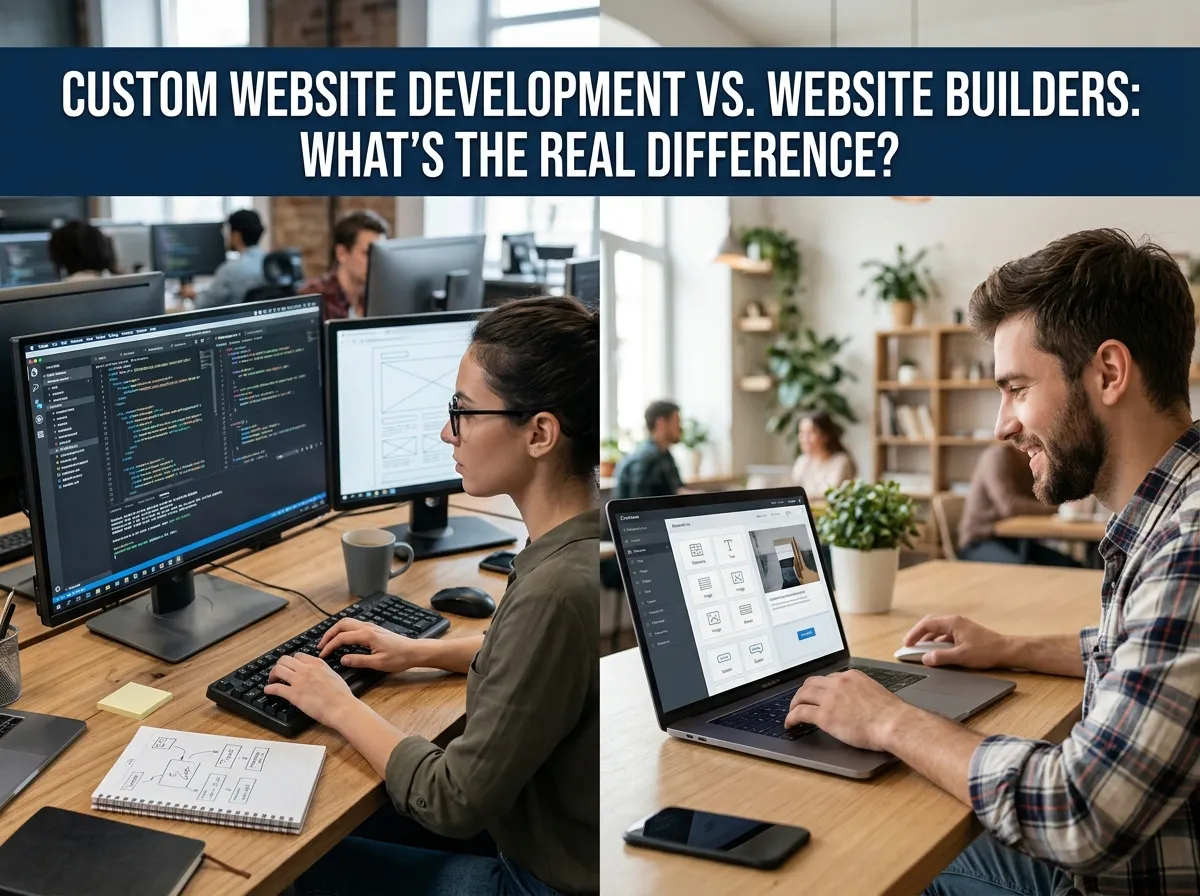
Choosing between a custom website vs website builder can be harder than it first appears. Builders promise a fast launch and simple editing. Custom development offers more control, but it takes more planning. Both can produce a good-looking site, so design alone does not tell you which one is right.
The better choice depends on what your website must do. A five-page service site has different needs from an online store, booking system, customer portal, or multi-location business. You also need to think about SEO, speed, ownership, updates, and future growth.
This guide explains the real differences in plain language. You will learn where Wix and Squarespace work well, where platform limits may appear, and when a custom build may be the smarter long-term choice.
What Is a Website Builder?
A website builder is an online platform that lets you make pages with visual tools. You choose a template, add text and images, move sections, and publish without building the whole site from code. Hosting, security, and many updates are handled by the platform.
Wix and Squarespace both include useful business and SEO tools. Wix lets users manage items such as URL slugs, index settings, meta tags, and structured data. Squarespace creates sitemaps, supports clean URLs, adds structured data, and includes mobile optimization. A builder can work well for a small site with common needs.
What Is a Custom Website?
A custom website is planned around one business. The design, page structure, forms, and features can support a clear goal, such as getting calls, booking jobs, selling products, or helping customers manage accounts.
Custom does not mean every update needs a developer. A content system can still let staff change text, images, products, or blog posts. The main difference is flexibility. The website can be shaped around the business instead of fitting the business into a fixed template.
Custom Website vs Website Builder: What Changes in Practice?
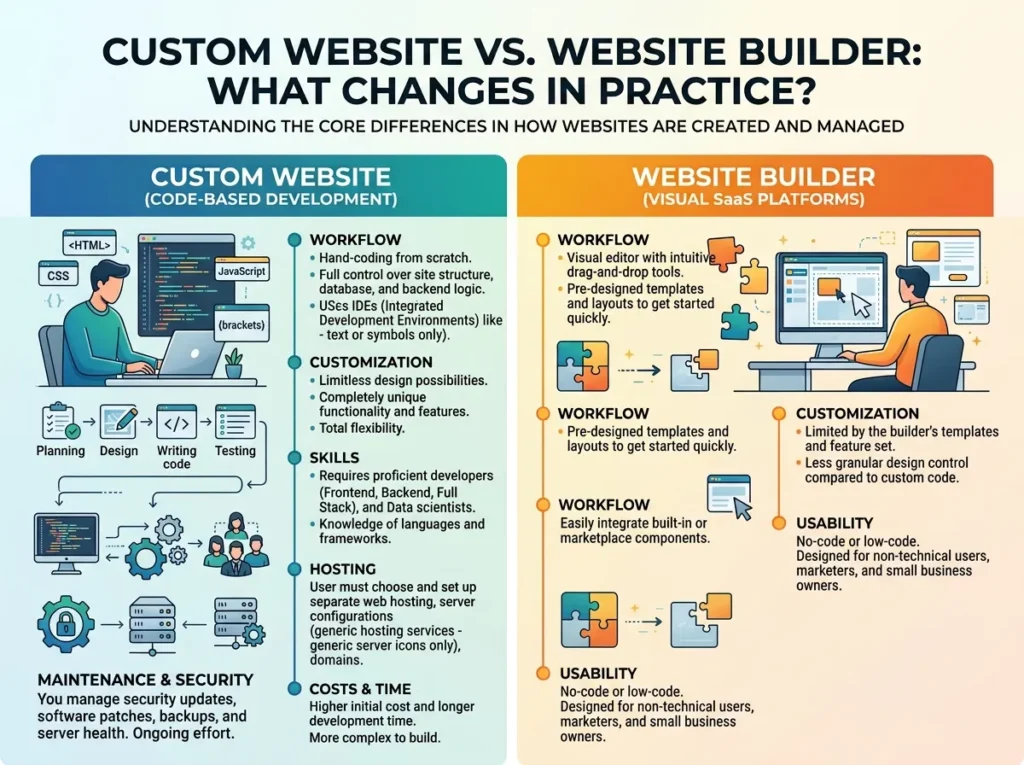
The main difference is control. A builder gives you a ready-made system. Custom development gives you more freedom to shape the system. Neither option is always better. The right choice depends on your design needs, tools, budget, and plans for growth.
Design and Brand Control
Website builders offer many polished templates. You can change colors, fonts, photos, buttons, and page sections. This may be enough for a new business that needs a clean site without a long design process.
Template limitations become clearer when you want a special page flow, menu, mobile layout, or content order. A custom site gives the design team more freedom. Each page can guide visitors toward a useful next step instead of following a fixed layout.
Features and Integrations
Builders include tools for forms, bookings, stores, email marketing, and social media. Extra apps can add more functions. This is useful when your needs match what the platform already offers.
Problems may start when several tools must work together. A lead form may need to send data to a CRM, create a task, notify a team member, and update a customer record. Custom development can connect these steps more closely. Businesses with deeper needs may also benefit from custom software development.
SEO Control
Website builders can rank on Google. It is not correct to say that Wix or Squarespace has no SEO support. Both platforms include core controls for titles, descriptions, URLs, mobile pages, and search settings.
The difference appears when a site needs advanced work. A growing business may need custom page types, detailed schema, large redirect plans, special filters, or changes across many pages. Custom development can offer deeper access to templates, code, hosting, and content structure. That does not guarantee rankings, but it gives the team more options.
Speed and Performance
A builder can load quickly when it uses a simple design, optimized images, and only a few apps. Wix says its platform uses caching, content delivery networks, and automatic image optimization.
Speed can drop when a site adds too many scripts, animations, tracking tools, or third-party apps. A custom site can have the same problem if it is poorly built. The benefit of custom code is control. A developer can remove unused features and decide how images, scripts, and page elements load.
Growth and Ownership
A builder may handle a small site, store, blog, or booking tool with ease. The challenge comes when the business adds many locations, users, products, or software connections. The scalability of custom code can make those changes easier when the system is planned well.
Ownership also matters. A builder keeps the design and many features inside its platform. Moving later may require a rebuild. A custom website can provide more control over files, databases, hosting, and code, but the contract should clearly state who owns each part.
What Are the Main Drag and Drop Website Builder Limitations?

The main limits are fixed platform rules, template boundaries, app dependence, and less control over the full system. These limits may not matter on a simple site. They matter more when the website must support a unique process.
Common issues include layouts that cannot be changed as expected, features that need several apps, or integrations that move only part of the needed data. Migration can also be hard because templates and apps may not transfer to a new platform.
Custom code can extend some builders. Squarespace allows code-based changes when a built-in feature is not available. However, its help center notes that these changes fall outside normal support and may not work fully with every responsive layout.
Wix Squarespace vs Custom Website: Which One Fits Best?
Wix or Squarespace may be a good fit when you need a simple site, want to launch quickly, and prefer to manage pages yourself. They can work well for portfolios, small service sites, event pages, basic stores, and new businesses with standard needs.
A custom website may be better when the site needs a unique design, complex forms, customer accounts, advanced integrations, or a large content plan. It may also make more sense when the website supports daily business work instead of acting only as an online brochure.
Do not choose custom development only because it sounds more advanced. Do not choose a builder only because it looks easier on day one. Compare both choices against the work the site must do now and later.
What Should Anaheim Businesses Consider?
Anaheim businesses often serve different groups at the same time. A restaurant may serve local residents and visitors. A contractor may work across several Orange County areas. A hotel, retailer, event vendor, or professional service company may also need to reach people who are searching from outside the city. That mix makes clear navigation and mobile use especially useful.
The right website setup depends on the business model. A restaurant near the resort area may need fast menus, online booking, directions, and pages that load well on a phone. A manufacturer or B2B company in Anaheim Canyon may need product details, quote forms, document downloads, and CRM connections. A home service company may need service-area pages and forms that sort leads by location.
A builder can support many of these needs when the process is simple. A custom system becomes more useful when several steps must work together. For example, a quote request may need to collect project details, send them to the right team member, create a CRM record, and trigger a follow-up message. That type of workflow is harder to manage with separate apps.
Anaheim’s visitor economy adds another reason to plan for mobile users. Visit Anaheim reported that the city welcomed 26.5 million visitors in 2025. Local hotels, restaurants, shops, and service providers often need people to find clear information while they are moving around the city.
For a company seeking custom website development in Anaheim, the first question should be simple: what should a visitor do next? The answer may be call, book, buy, request a quote, or visit a location. The website should make that action easy without forcing users through extra steps.
An Anaheim website development company should also plan for future changes, such as new service areas, staff members, seasonal offers, or business tools. You can review website development services to compare a tailored build with a standard platform.
How Do Cost and Maintenance Differ?
A builder usually has a lower starting barrier. Costs may include the platform plan, domain, template, apps, and payment fees. Many technical tasks are grouped into one service, which can make the site easier to manage.
Custom development often needs a larger first project because the design and features are built for the business. It may also need hosting, backups, security checks, testing, and developer support.
Do not compare only the launch cost. Look at paid apps, future redesigns, staff time, support, and the cost of moving if the platform no longer fits. The cheaper choice today is not always the cheaper choice over several years.
How Can You Choose the Right Option?
Start with the work the website must do. A clear list of needs helps you avoid paying for features that do not help customers.
Ask these questions:
- How many pages, products, or locations will the site need?
- Will customers log in, book, pay, or upload files?
- Does the site need to connect with a CRM?
- Who will update the content?
- What features may be added later?
- Can the site move if the platform no longer fits?
- Who will handle support and maintenance?
A builder is often enough when the answers are simple. Custom development becomes more useful when several answers involve special workflows or future growth.
Frequently Asked Questions
Can a Wix or Squarespace Website Rank on Google?
Yes. Both platforms include built-in SEO features. Rankings still depend on useful content, search intent, competition, site quality, links, and user experience.
Is a Custom Website Always Better?
No. A custom site is better only when its extra control solves a real need. A small business with a few pages may get everything it needs from a builder.
What Is the Biggest Website Builder Limitation?
The biggest limit is platform dependence. Your design and tools must work within the builder’s system. If the platform cannot support a key feature, you may need an app, custom code, or a rebuild.
Can I Move From a Builder to a Custom Website Later?
Yes, but it is often a rebuild rather than a simple transfer. Text and images may move easily. Templates, apps, forms, and custom functions may need to be created again.
Do Custom Websites Need Maintenance?
Yes. A custom site needs updates, backups, security checks, testing, and performance care. The level of work depends on the technology and features used.
Which Option Is Best for a Growing Local Business?
A builder may be enough if growth means adding a few pages or products. A custom site may be better when growth includes new locations, integrations, customer accounts, or special tools.
Final Thoughts
The custom website vs website builder decision comes down to fit. Builders offer convenience, built-in tools, and a faster path for common needs. Custom development offers more freedom over design, features, ownership, and future growth.
Choose the simplest option that can support your real goals. A small site does not need extra complexity. A growing business should not be held back by a platform that cannot support its next step.
For help comparing both paths, contact All 4 One Local to discuss your goals, required features, and plans for growth.