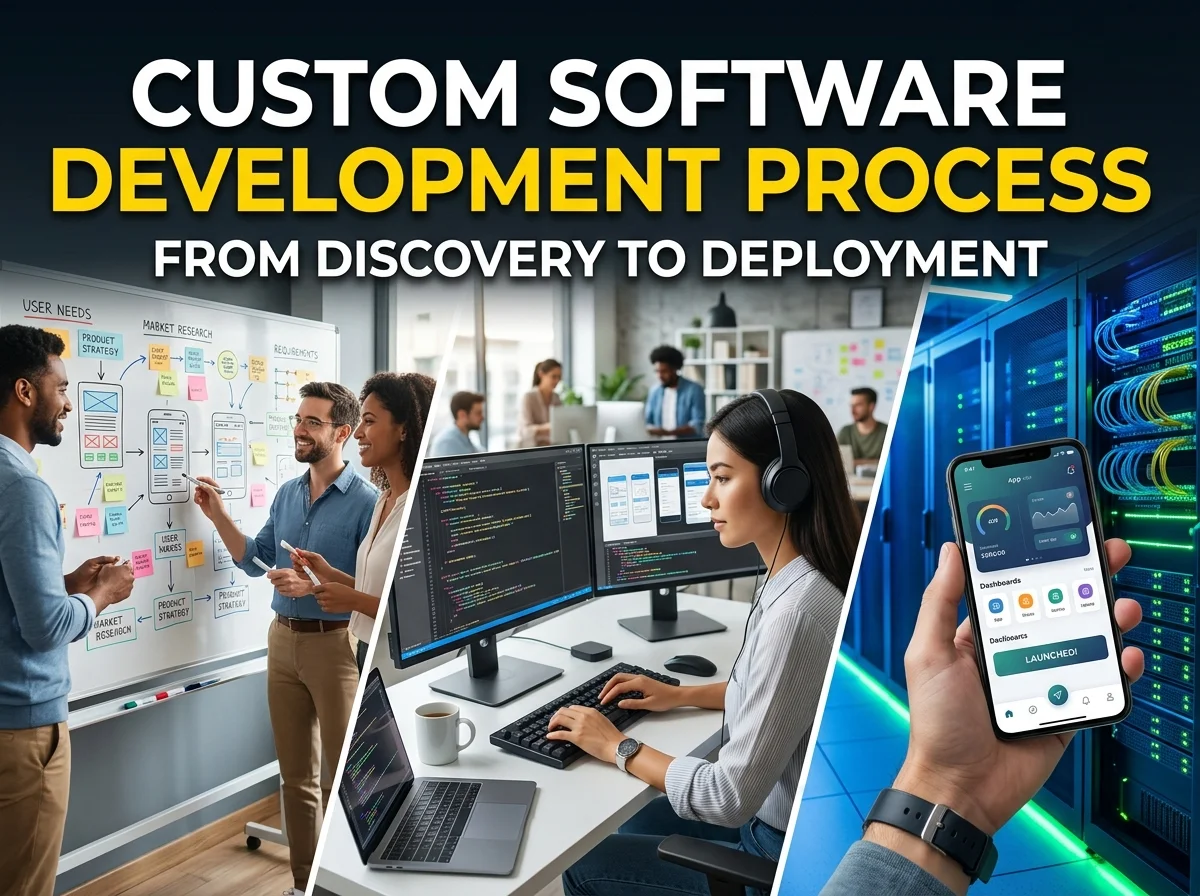
A successful software product usually starts long before a developer writes the first line of code. The team must grasp the business challenge and identify the desired outcome of the product, design the user experience, create the appropriate technology, conduct thorough testing, and finalize the product for actual users.
Understanding the software development process steps gives business owners a clearer view of what happens between an initial idea and a working product. From initial design through development and subsequent testing, every step helps to mitigate uncertainty before the next significant investment.
Start With the Problem, Not the Technology
In the first phase of a software project, the question is asked: what is the business problem that the software should address?
During the discovery phase, software project teams typically examine business goals, existing workflows, users, technical limitations, and the expected outcome. This is also the time to conduct market research, interviews with stakeholders, and early feasibility discussions to help uncover challenges.
A useful discovery process may define the main business objectives, target users, existing systems, required features, integration needs, security considerations, timeline, and budget assumptions. For businesses planning a project in Anaheim, understanding custom software development costs in Anaheim can also help set realistic budget expectations during the early planning stage.
- The main business objectives
- Target users and their needs
- Existing systems and processes
- Required features
- Integration requirements
- Security and privacy considerations
- Initial project timeline
- Budget assumptions and cost estimation
The result should not simply be a collection of ideas. It should provide enough details to the development team to create a realistic direction for the development project.
Turn Requirements Into a Working Blueprint
After you know what the issue is, you need to make the concepts into actual project specifications. During requirements gathering, it should be clear what users are supposed to be able to do, what data the system has to process, and how different aspects of the product should relate to one another. A requirements specification can then provide a common point of reference for developers, designers, and project managers.
This stage often includes:
User flows: Map how users move through important tasks.
Wireframing: Design a rough sketch of the layout of a web page or design before spending time on the full visual design.
Technical planning: Determine the architecture, platforms, databases, integrations, and other technical needs.
Scope definition: Make sure to distinguish necessary features at launch from features that can be added later.
This planning can save the developer from an expensive situation where they find significant requirements once development has begun, especially for complex projects.
Shape the User Experience Before Building
Even with a good application, if the interface is not intuitive, it can be difficult to use. Therefore, it’s important to look at design as part of the software project itself, not an afterthought. Wireframes and Prototypes can be used for designers to visualise how screens connect and how users perform key tasks. The team can consider these user interfaces before development is started, and changes are easier.
For example, a business in Anaheim that is building a customer portal might require distinct experiences for customers, employees, and administrators. Identification of those roles early on can affect the way things are navigated, permissions, dashboards, and system architecture.
Build in Manageable Pieces
Once the requirements and design direction are defined, the development teams can start to develop the software. Many modern projects don’t go for a once-and-for-all development, but rather they have incremental development instead. Agile sprints can be used to break down the work into smaller chunks, enabling the team to build features, go through the process of review, discuss problems, and change priorities throughout the course of the project.
A development cycle usually unfolds as follows:
- Select a defined group of requirements.
- Develop the functionality.
- Review the completed work.
- Test the feature.
- Fix identified issues.
- Move the approved work toward the next development cycle.
This can help if requirements might change. But project management is still required when changes do occur. Adding features without taking into account their impact on scope, cost, and schedule can cause delays.
Test the Product Before Customers Do
Quality assurance testing is not a last-minute inspection. Testing should be done throughout the development process in order to detect problems early on in the development process when they can be corrected more easily.
Depending on the software, quality assurance may include:
- Functional testing
- Integration testing
- Compatibility testing
- Performance testing
- Security testing
- User acceptance testing
The aim is to verify that features function as designed, and that various components of the software interact appropriately. Security is also present throughout the software development life cycle. NIST’s Secure Software Development Framework suggests that secure software development practices must be a part of the software development process and not an afterthought.
Privacy should also be taken into account during the planning and development of California businesses that collect personal information. The California Consumer Privacy Act gives applicable consumers rights regarding their personal data, including rights of access, deletion, and sale of or disclosure of the personal data for certain purposes.
Prepare for Deployment and Launch
When the software is ready to move towards its actual operating environment, it’s in the deployment stage. But going live isn’t just about the uploads or application publishing. Prior to launch, the team can have to establish production infrastructure, move accepted data, set up user permissions, verify backups, review monitoring, and perform acceptance checks.
A launch checklist can include:
- Production environment configuration
- Database preparation
- Security verification
- Backup procedures
- User account setup
- Domain or application configuration
- Final quality checks
- Support and communication plans
For businesses that already have some type of systems in place, deployment may have to be staged to minimize disruption. A carefully planned transition gives the team an opportunity to identify issues before all users depend on the new system.
Launch Is the Beginning of the Next Cycle
When a software product is launched, it’s not necessarily a finished product. Problems can be identified, business needs can change, operating systems can be updated, and new opportunities can be discovered. Post-launch support can include bug fixes, performance monitoring, security updates, infrastructure maintenance, and feature improvements. This is a continuous process within the development life cycle.
It is also useful to collect actual user feedback after launch. A feature that was thought to be essential at design time can be used very little, whereas other users may find that there is another way of working that is needed.
Choosing the Right Development Approach
There is no universal process that works identically for every software project. For a small internal tool, it may be much easier if there is less of an ecosystem of integrations and users involved.
When you’re sizing up a development partner, dig into how the team deals with requirements, scope changes, design reviews, testing, communication, deployment, and post-launch support. Businesses comparing their options can also use this custom software development guide for Anaheim, CA to better understand what to consider when planning a project.
A good process should make responsibilities obvious. All 4 One Local helps businesses tackle custom software projects with a clear roadmap, and its software development services can support the project from planning through launch.
Frequently Asked Questions
What are the main software development process steps?
Usually, you’ll see discovery, requirements definition, design, development, testing, deployment, and ongoing support. But the structure can shift depending on the project.
What happens during the software project discovery phase?
Discovery is all about understanding the business problem, who the users are, requirements, what systems are already in place, technical limits, and what everyone actually wants to achieve. The team will also spot risks and clarify the project’s scope before launching into serious development.
Why are requirements gathering and wireframing important?
Requirements spell out what the software must do. Wireframes give you an early look at how people will use the system. Reviewing both before development often uncovers confusing workflows or missing features before they turn into expensive fixes.
How long does the software development life cycle take?
There’s no one answer. A streamlined app often wraps up far sooner than a big, complex system stacked with integrations, user roles, or strict security needs. How big the project is, team size, how quickly you get feedback, the technical challenge, and level of testing all play into the timeline.
Final Thoughts: A Better Software Process Starts Before Development
Software development steps exist to turn unclear ideas into something you can organize, build, test, launch, and grow. Discovery defines the problem, requirements set the boundaries, design shapes the experience, development builds the product, and testing makes sure it’s ready for real users.
If you’re planning custom software, don’t just focus on the tech. Give the process itself the same attention. All 4 One Local offers a structured approach that keeps business goals, user needs, development, and future support in sync from start to finish.
If you’re ready to discuss your software project, contact All 4 One Local about your development needs and discuss the goals, scope, and next steps for your project.