


A homeowner planning a kitchen or bathroom remodel rarely calls the first contractor they find. They look at photos, compare a few companies, and decide who deserves a phone call, often before anyone has spoken to them. For a remodeling company, the website does that first round of selling. Website development for remodeling businesses is therefore less about looking modern and more about building a site that answers the right questions and makes it easy to ask for an estimate.
This guide covers what a remodeling contractor website needs to turn visitors into qualified inquiries. It explains how the project portfolio, service pages, forms, mobile performance and trust signals each affect lead quality, and where many sites lose people. All4One Local, a web development agency in Anaheim, CA, builds custom websites for local businesses, so the guidance below is written from a build-and-conversion point of view.
Why Remodeling Websites Need a Different Approach
A remodel is a large, infrequent purchase. The buyer is letting a crew into their home and committing to weeks of disruption. That makes trust the main barrier, and a generic business template rarely addresses it.
A qualified lead in this trade is a homeowner who is in the right area, wants a service the company offers, and has a project at a stage where an estimate is useful. Raw traffic and form counts say little about that. A site that attracts fifty curious visitors and two serious ones is working worse than a site that attracts ten visitors who all want a bathroom remodel in the company’s service area.
Three things separate remodeling business online presence from a basic brochure site:
- Visual proof. Buyers are judging craftsmanship they can’t inspect in person.
- Specific service coverage. “Remodeling” is too vague. People search for kitchens, bathrooms, basements and additions separately.
- Local relevance. Homeowners want a contractor who works in their city.
What Homeowners Look For Before Requesting an Estimate
Most visitors scan before they read. They look for evidence that the company does the kind of work they want, at a quality they like, in their area.
The project portfolio carries the most weight. A strong gallery groups work by project type, so a visitor planning a bathroom can see bathrooms without scrolling through decks and kitchens. Before and after photos show the scale of the transformation, and a short caption adds context: the room, the scope of work and the neighborhood or city. Captions also give search engines text to understand the images.
Beyond photos, visitors look for:
- A clear statement of which remodeling services are offered
- The areas served
- A visible way to ask for a project estimate
- Signs that the company is a real, established local business, such as a physical address, a phone number and a named team
If any of those are hard to find, visitors leave and try the next contractor. Placing them in the header, footer and key pages removes that friction.
Core Features Every Remodeling Contractor Website Needs
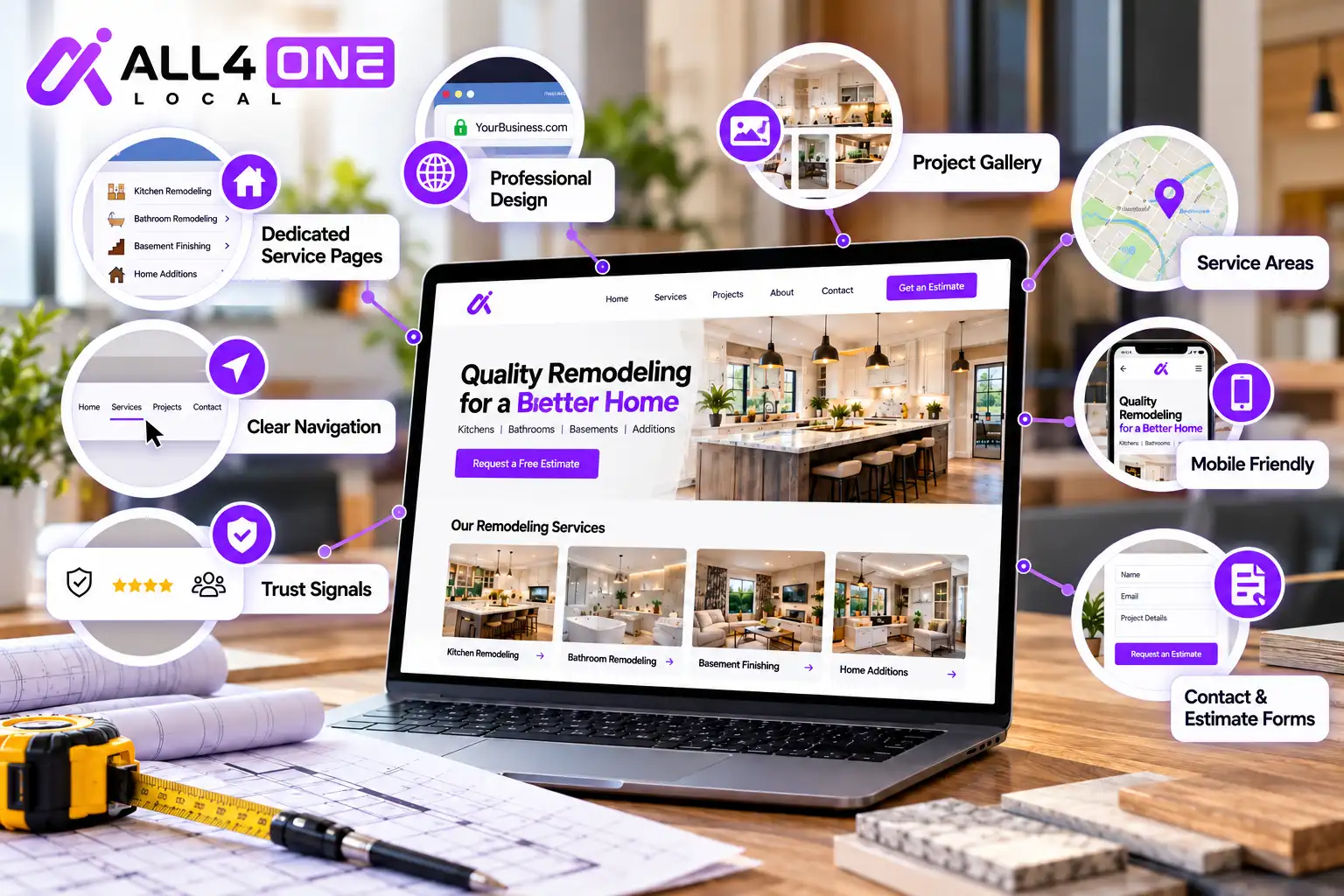
The remodeling company website features that matter most are the ones that serve the buyer’s decision, not the ones that look impressive in a demo.
Dedicated service pages. Each major service, such as kitchen remodeling, bathroom remodeling or basement finishing, should have its own page. A single “Services” page listing everything in one paragraph gives search engines little to rank and gives visitors little to act on. A good service page describes the typical scope, shows relevant projects, explains how the process works and ends with a clear request for an estimate.
Project galleries. Galleries should load quickly, be organized by project type, and use descriptive file names and alt text. Oversized, uncompressed photos are a common cause of slow remodeling sites, which leads to the next section.
Clear navigation. Visitors should reach any service, the portfolio or the contact page within a couple of clicks. Simple labels outperform clever ones.
Click-to-call and estimate buttons. On a phone, a tappable number and a visible estimate button save effort at the moment someone is ready to reach out.
For businesses that need something beyond a template, such as custom layouts, a content management system the team can edit, or integrations with scheduling or customer management tools, All4One Local’s website development services describe the platforms and approach it uses for custom builds.
Mobile Experience and Page Speed
Many homeowners research contractors on a phone, often while looking at the room they want changed. Mobile experience also has a direct search impact. Google uses the mobile version of a site’s content for indexing and ranking, and its guidance says the mobile page should contain the same primary content as the desktop page. Content hidden or removed on mobile may not be indexed. Google recommends responsive design, which serves the same page to all devices, as the simplest setup to maintain.
For a remodeling site, this means the full portfolio captions, service descriptions and contact details must appear on mobile, not a trimmed version.
Speed matters as well. Google’s Core Web Vitals measure real-world page experience across three areas:
| Metric | What it measures | “Good” threshold |
| Largest Contentful Paint (LCP) | Loading speed | Within 2.5 seconds |
| Interaction to Next Paint (INP) | Responsiveness | Under 200 milliseconds |
| Cumulative Layout Shift (CLS) | Visual stability | Below 0.1 |
Google presents these as targets that support both search performance and user experience, not as a guaranteed ranking boost on their own. Photo-heavy contractor sites often struggle with LCP, because a large hero image or gallery loads slowly. Compressing images, using modern formats, loading galleries lazily and avoiding layout jumps as images appear all help. Google’s PageSpeed Insights and Search Console reports can show where a specific site stands.
Local Search Visibility for Remodelers
A remodeler serves a defined territory, so local search visibility drives most qualified traffic. A homeowner searching for a bathroom remodeler in a particular city is far more likely to hire than a visitor from across the country.
Several website elements support this:
- Service area pages. If a company works in several cities, each can have a page describing the work done there. These pages need real local content, such as typical home styles, project examples and neighborhood details. Near-identical pages with only the city name swapped tend to add little value.
- Consistent business details. The business name, address and phone number should match across the website and other listings.
- Structured data. Google documents LocalBusiness structured data, which lets a site describe its name, address, phone number and hours in a machine-readable format. It helps search engines interpret the information on the page.
- Locally relevant titles and headings. Page titles and headings should name the service and the area in plain language.
Search optimization works best when it is built into the site from the start, not added afterward. All4One Local’s guide on website development and SEO integration explains how site structure, page speed and content planning fit together.
Building Trust With Testimonials and Credentials
Trust signals do heavy lifting on a remodeling site, but they need to be genuine, and in some cases they are regulated.
Customer testimonials. Real quotes from past clients, ideally paired with the project they describe, persuade better than generic praise. In the United States, the Federal Trade Commission has a final rule banning fake reviews and testimonials. It prohibits reviews from people who don’t exist or don’t have real experience with the business, buying reviews that express a particular sentiment, and undisclosed insider reviews. It also bars using threats or intimidation to suppress negative reviews, and claiming that the reviews shown represent all reviews when negative ones were hidden. Civil penalties can apply to knowing violations. Every testimonial on a contractor site should come from a real customer, and invented or copied reviews should never be published.
License information. Licensing rules vary by state, and contractors should confirm what applies to them. In California, the Contractors State License Board states that licensed contractors must include their license number in all forms of advertising, and its rules define advertising to include company website content. The listed penalty for failing to comply is a civil penalty of $100 to $1,000 for a first offense. Contractors in California should confirm current requirements directly with the CSLB, and contractors elsewhere should check their own state board.
Other credible trust elements include a real team page, a physical address, details of the remodeling process, and only those certifications or affiliations the company actually holds.
Lead Capture Forms and Conversion Optimization
Traffic only becomes revenue when visitors reach out. Remodeling website conversion optimization focuses on removing the obstacles between interest and inquiry.
Keep forms short, but ask the right questions. Long forms discourage submissions, while very short ones produce vague leads. A practical middle ground asks for name, phone or email, the type of project, and the property location. An optional field for a short project description helps the contractor judge fit before calling back. These few extra fields act as a filter, so the customer inquiries that arrive are more likely to be qualified.
Place the request option in several spots. A form or button should appear on service pages, near the portfolio and in the footer, not only on a contact page.
Say what happens next. A short line such as “the team will review your request and follow up” sets expectations, as long as it describes what the business actually does. Promises that the company can’t keep, such as same-day replies, should be left out.
Use dedicated landing pages for campaigns. Visitors from paid ads or specific promotions convert better on a focused page with one message and one action. All4One Local’s article on landing page optimization for PPC conversions covers how to structure these pages.
Common Mistakes That Cost Remodelers Leads
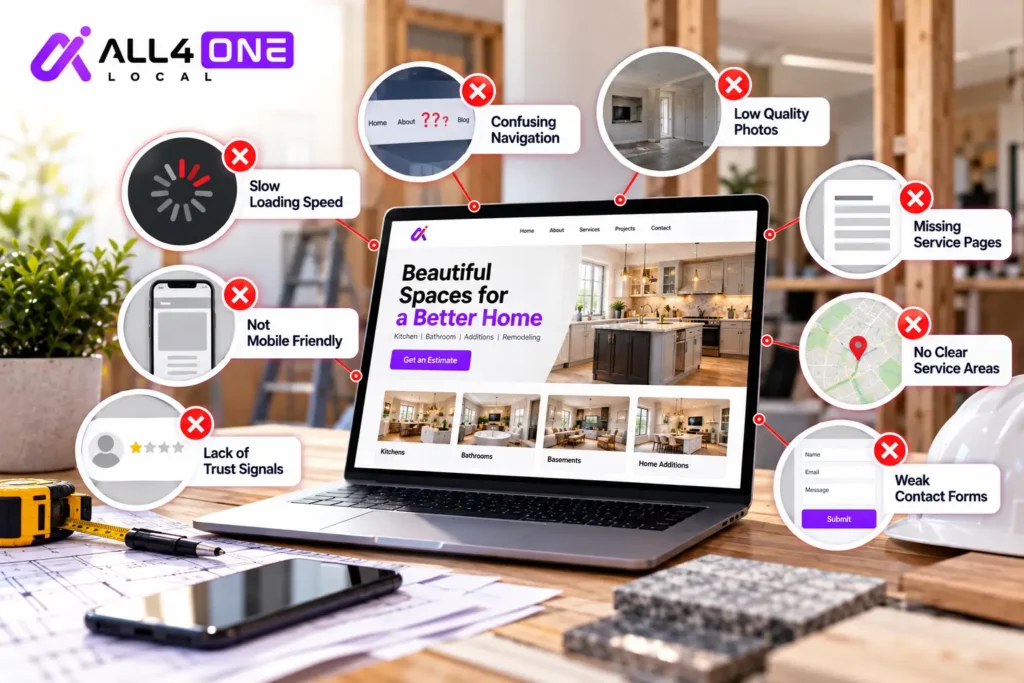
Several recurring problems reduce both lead volume and lead quality:
- A single catch-all services page that doesn’t rank for any specific service.
- Low-quality or unlabeled photos that don’t show finished work clearly.
- Slow-loading galleries that push mobile visitors away.
- A contact form buried on one page, or one that fails silently.
- No service area information, leaving visitors unsure whether the company works near them.
- Outdated content, such as old project photos, dead links or a copyright year from several years back.
- Unverified or copied reviews, which can damage trust and create legal risk.
- No way to track where inquiries come from, which makes it impossible to improve.
Measuring Whether the Website Is Producing Qualified Leads
A site that can’t be measured can’t be improved. At a minimum, a remodeling company should track:
- Form submissions and phone calls, separated by source where possible
- Which service pages and city pages bring the most inquiries
- Mobile versus desktop behavior
- The share of inquiries that turn into estimates and signed projects
The final measure matters most. A site may generate many inquiries, yet if most don’t match the company’s services or budget range, the content and forms need adjusting. Reviewing this data regularly shows which pages deserve more investment.
Planning a Remodeling Website Project
Before development begins, a remodeling company should settle a few decisions: which services bring the best margins, which areas it wants to serve, which projects make the strongest portfolio entries, and who will keep the site updated. A site built around those answers tends to attract better-fitting leads than one built around a template.
A remodeling website works best when portfolio content, service pages, local search structure, mobile performance and lead capture are planned together instead of patched in one at a time. To discuss a project, contact All4One Local or call (714) 439-2552.