You’re running PPC ads. Your budget is limited. Costs are too high. You’re not getting results. But before diving into optimization tactics, it helps to understand PPC advertising in the broader context. Check out our comprehensive PPC advertising strategy first to ensure your campaigns are built on the right foundation
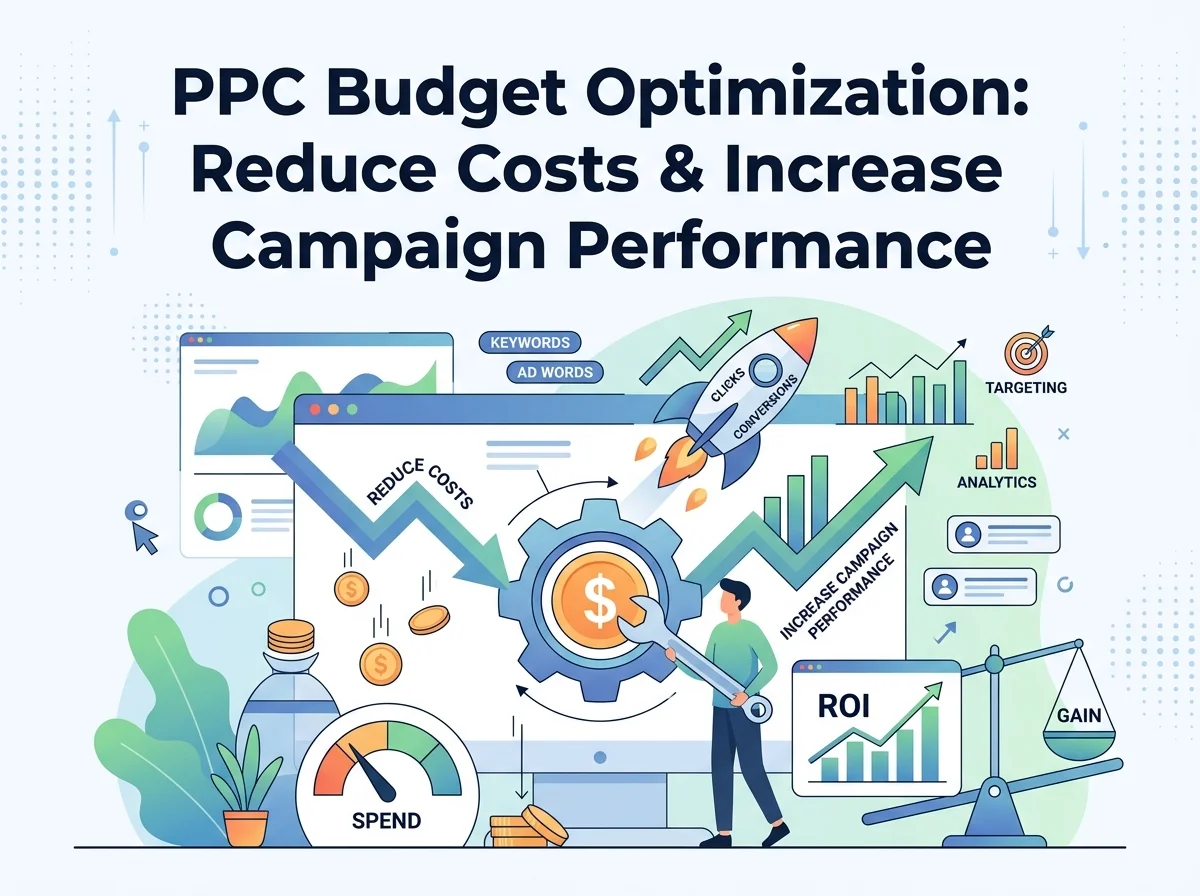
This is fixable. PPC budget optimization makes ads work better. Spend less. Get more customers. It’s possible. This guide covers everything. Why optimization matters. Cost per click reduction strategies. Bid management techniques. Negative keywords importance. Smart budget allocation. Achieving cost efficiency. Real results. Smart decisions.
By the end, you’ll know how to cut costs. You’ll know how to improve performance. You’ll spend money smarter. You’ll get better results.
Why PPC Budget Optimization Matters
Optimization changes everything.
Money Wasted is Common
Most businesses waste 30-50% of ad spend. Wrong targeting. Bad keywords. Poor bids. Wasted clicks. Wasted money.
Optimization prevents this. Stops waste. Recovers money. Increases profits.
Small Changes = Big Impact
Reducing cost per click 10%. Improving conversion 5%. Small changes. Huge impact. Profit increases significantly.
Optimization finds these small wins. Compounds them. Creates big results.
Competition Keeps Rising
More businesses advertise now. Costs increase. Harder to compete. Optimization is essential. Without it, you lose.
Optimization keeps you competitive. Keeps costs manageable.
Scaling Requires Efficiency
Want more customers? Need more budget. But budget is limited. Efficiency is answer. Spend less. Get more. Scale profitably.
Optimization enables scaling. Without it, scaling is too expensive.
Understanding Cost Per Click Reduction: Lowering Your Costs
Lower costs are the goal. Reducing cost per click is critical, but one often-overlooked strategy is retargeting. Retargeting brings back warm, interested visitors people who already know your business. These visitors typically convert at higher rates and cost less per acquisition than cold traffic. Consider Retargeting higher-intent audiences for lower costs and faster conversions.
What Affects Cost
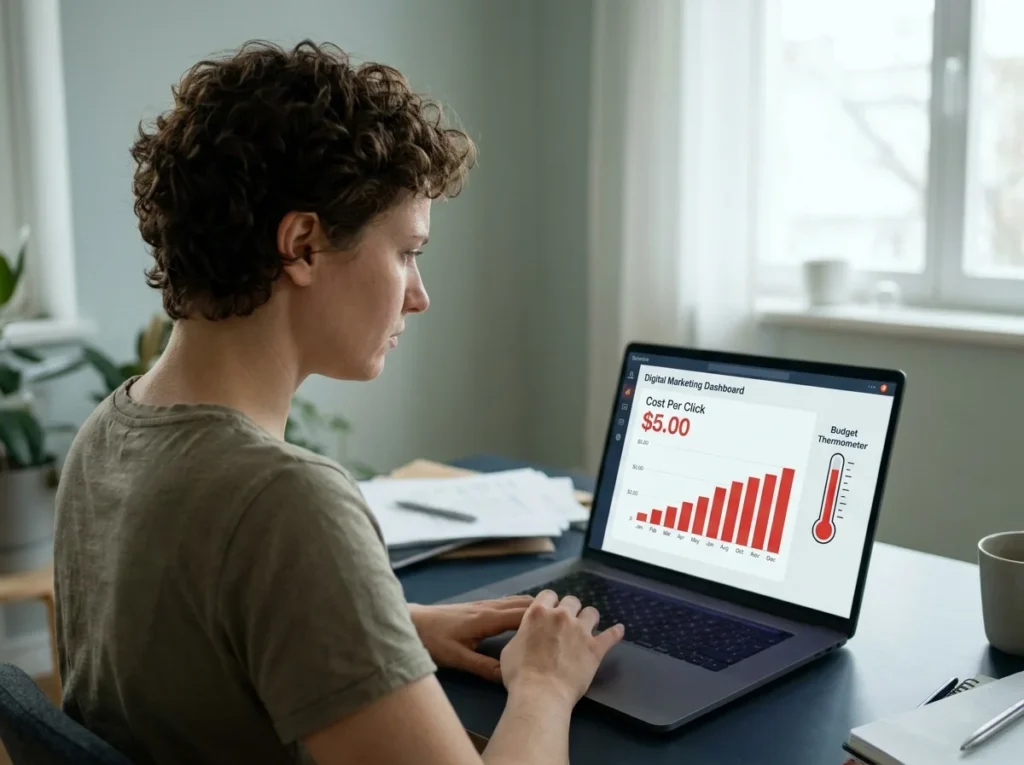
Quality score affects cost most. Relevance matters. CTR matters. Landing page matters. Better quality = lower cost.
Bid amount affects cost. Higher bids = higher cost. Lower bids = lower cost. But relevance matters more.
Competition affects cost. More competitors = higher cost. Less competition = lower cost. Can’t control this. Can optimize response.
Improving Quality Score
Quality score is 1-10. Higher is better. Google scores based on relevance. Click-through rate. Landing page quality.
Improve all three. Better relevance. Better CTR. Better landing page. Quality score increases. Cost decreases.
Ad Relevance
Ad must match keyword. Person searches “blue shoes.” Your ad says “blue shoes.” Relevant. Quality increases.
Generic ads underperform. Specific ads outperform. Relevance is critical.
Click-Through Rate
CTR is clicks divided by impressions. Higher CTR = better quality. Better headlines. Better ad copy. Better CTAs. Higher CTR.
Test headlines. Test copy. Test CTAs. Improve CTR. Cost decreases.
Landing Page Quality
Person clicks ad. Lands on page. Page must match ad promise. Must have clear benefit. Must have call-to-action.
Poor landing page. High bounce rate. Low quality score. Cost increases. Good landing page. Low bounce rate. High quality. Cost decreases.
Bid Management: Smart Bidding Strategies
Managing bids carefully controls costs.
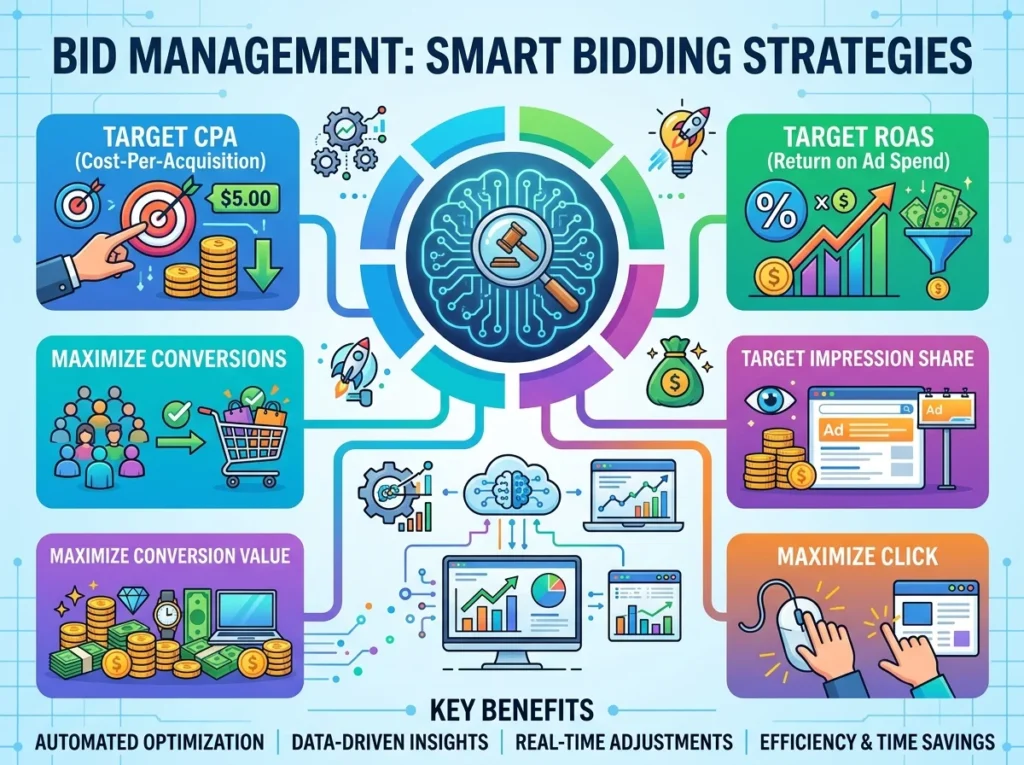
Understanding Bidding
You set maximum bid. You’ll pay per click. Google adjusts to win auctions. But pays less if possible.
Bid too high. Pay too much. Bid too low. Don’t get clicks. Balance matters.
Manual Bidding
Manual bid management works for small campaigns, but as you scale, managing bids across dozens of keywords and campaigns becomes time-consuming. Many businesses benefit from professional bid management and campaign optimization services that use advanced tools and real-time data to constantly adjust bids for maximum efficiency
Automated Bidding
Google controls bids automatically. Target cost per acquisition. Target return on ad spend. Hands-off approach. Less control. More convenient.
Works well once optimized. Requires data. Requires patience for algorithm to learn.
Bid Adjustments
Adjust bids by device. Mobile bids lower usually. Desktop bids higher. Tablet middle.
Adjust by location. Profitable locations higher bids. Unprofitable lower bids.
Adjust by time. Peak hours higher bids. Off-hours lower bids. Targets customers when present.
Lowering Bids Strategically
Lower bids on unprofitable keywords. Unprofitable keywords waste money. Lower bids. Reduce impressions. Focus on profitable keywords.
Test lower bids. Monitor results. Find balance. Lower costs. Maintain customers.
Negative Keywords: Preventing Wasted Clicks
Negative keywords stop waste.
What Are Negative Keywords?
Words you don’t want. Exclude these searches. Ad doesn’t show. Save money.
Example: You sell expensive countertops. Add “cheap” as negative keyword. Ad doesn’t show for “cheap countertops.” Saves money. Prevents wasted clicks.
Finding Negative Keywords
Review search terms. What searches triggered your ads? Which ones aren’t relevant? Add those as negatives.
Search term report shows everything. Use it. Find wasted clicks. Add negatives. Stop waste.
Types of Negatives
Broad match negative. Exact match negative. Phrase match negative. Different match types. Different control levels.
Exact match most control. Phrase match some control. Broad match least control.
Common Negative Keywords
“Free” if you don’t offer free. “DIY” if you’re service-based. “Cheap” if you’re premium. “Competitor name” if you don’t want competing with them.
Think about business. Identify irrelevant searches. Add negatives. Stop waste.
Ongoing Management
Add negatives continuously. Review search terms monthly. Find new wasted clicks. Add negatives. Never stop optimizing.
Negatives are ongoing. Not one-time task. Continuous improvement.
Budget Allocation: Spending Smart
Where you spend matters most.
Test New Campaigns Small
New campaign? Start small budget. $5-$10 daily. Test market. See what works. Scale winners.
Don’t risk huge budget. Test first. Then scale. Smart approach.
Allocate to Winners
High-performing keywords? Increase budget. More budget = more customers. More customers = more profit.
Low-performing keywords? Decrease budget. Waste less money. Focus on winners.
Seasonal Adjustments
Busy season? Increase budget. Customers available. More spend = more customers.
Slow season? Decrease budget. Few customers. Maintain presence. But don’t overspend.
Geographic Allocation
Profitable locations? Higher budget. Unprofitable locations? Lower budget. Focus on winners.
Different regions perform differently. Allocate accordingly.
Device Allocation
Mobile high performing? Increase mobile budget. Desktop underperforming? Decrease desktop budget. Data-driven allocation.
Strategies for Cost Efficiency: Maximizing Returns
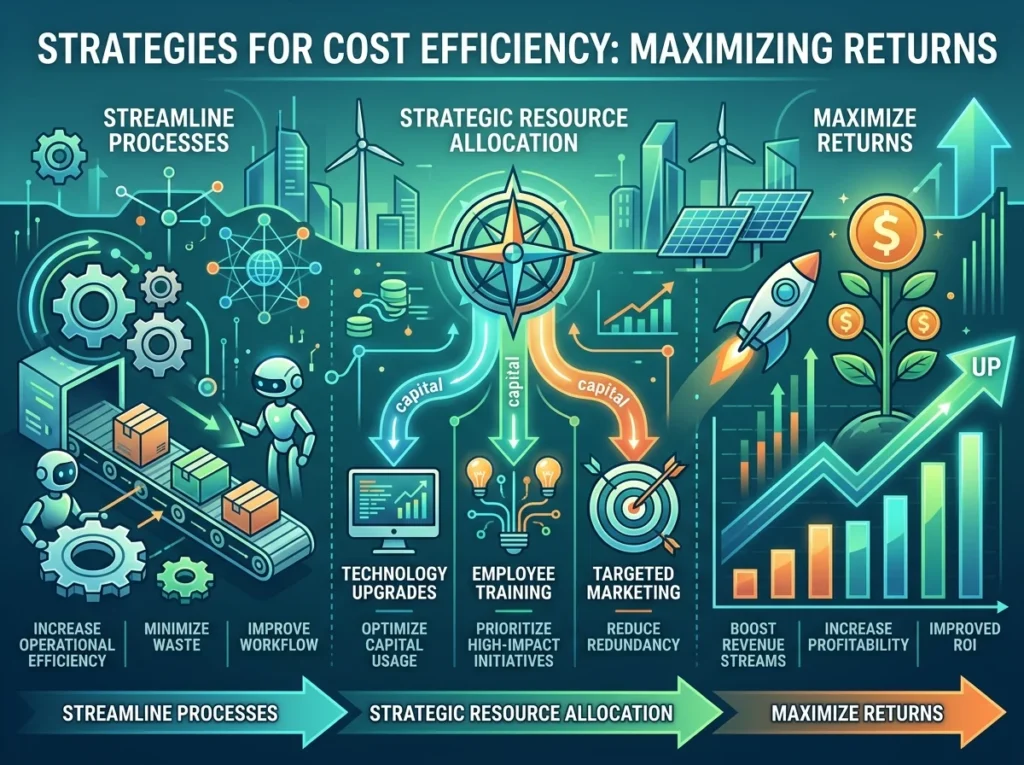
Efficiency is the goal.
Improve Landing Pages
Better landing pages = higher conversion. Same clicks. More conversions. Lower cost per customer.
Test landing pages. A/B testing. Different headlines. Different layouts. Different CTAs. Find winners.
Tighter Targeting
Broad targeting = wasted clicks. Tight targeting = qualified clicks. More qualified = higher conversion. Lower cost per customer.
Define audience clearly. Target precisely. Get better results.
Ad Schedule Optimization
Show ads only when customers available. 9-5 if B2B. Evening if B2C. Peak hours only. Save budget.
Don’t waste budget off-hours. Show ads when customers can respond.
Keyword Quality
Remove low-quality keywords. Keyword with high cost. Low conversion. Remove it. Focus on quality keywords.
Review keywords monthly. Remove underperformers. Reallocate budget. Improve efficiency.
Conversion Tracking
Track conversions accurately. Know which keywords convert. Which don’t. Invest in converters. Cut non-converters.
Can’t optimize without data. Track everything. Then optimize.
Regular Audits
Monthly audit campaigns. Review performance. Identify waste. Fix problems. Optimize continuously.
Never stop optimizing. Continuous improvement = continuous savings.
Measuring PPC Budget Optimization Success
How to know if optimization works.
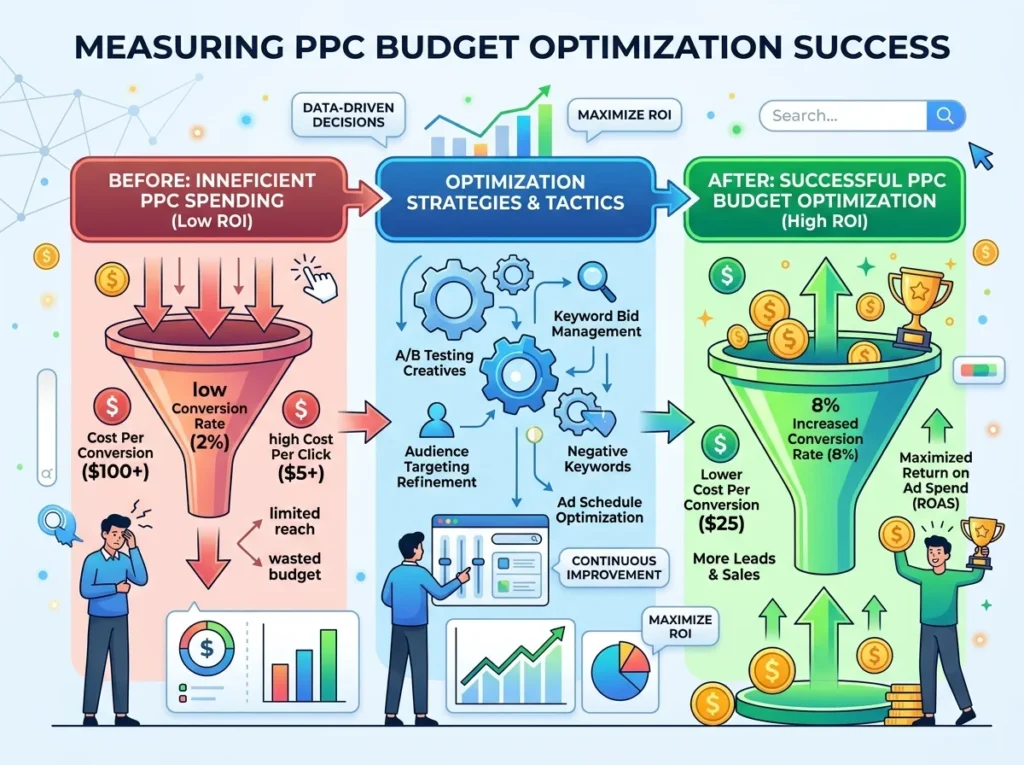
Cost Per Acquisition
Track this metric. Customers cost X dollars. Goal: lower X. Optimization works if X decreases.
Compare month to month. Year to year. Track trends. Success is declining cost.
Return on Ad Spend
Revenue divided by ad spend. ROAS of 3 is good. Revenue three times ad spend. Higher ROAS is better.
Track ROAS. Improvement means optimization working.
Conversion Rate
Clicks to customers percentage. 1% is typical. 2% is good. 3%+ is excellent.
Improve conversion rate. Same clicks. More customers. Cost per customer decreases.
Click-Through Rate
Clicks divided by impressions. Higher CTR = better ads. Better quality. Lower cost.
Track CTR. Improvement means optimization working.
Quality Score
Google metric. 1-10 scale. Higher is better. Track scores. Improvement means optimization working.
FAQ About PPC Budget Optimization
How much can I save with optimization?
Typical savings: 15-30%. Depends on starting point. Poor campaigns: save more. Well-run campaigns: save less.
Conservative estimate: 15-20%. That’s significant. Worth effort.
What’s the best bid management strategy?
Automated bidding for most. Target cost per acquisition works well. Less work. Better results usually.
Manual bidding if learning. If testing. If very specific needs.
How often should I review negative keywords?
Monthly minimum. Review search terms. Find new wasted clicks. Add negatives. Ongoing task. Never stop.
Weekly if budget is large. Daily if very focused. Monthly is good baseline.
What’s ideal budget allocation breakdown?
80/20 rule works. 80% to proven winners. 20% to testing and new campaigns.
Adjust based on situation. But 80/20 is good starting point.
How long until I see cost efficiency improvements?
2-4 weeks for changes to show. Need data. Need samples. Then trends emerge.
Patience required. But improvements come. Consistent work pays off.
Should I hire expert for optimization?
If budget is large. If time is limited. Hire expert. Cost: $500-$2,000 monthly.
If budget is small. If you have time. DIY works. Learning curve: 2-3 months.