
Your sales team is losing deals without proper tracking systems right now. You’re losing track of customer information and sales opportunities constantly. You want CRM benefits that actually improve your sales results. Understanding customer relationship management helps you serve customers better. Selecting the right CRM software is critical decision. CRM implementation requires careful evaluation and planning. Sales pipeline management improves efficiency and saves time daily. Lead tracking keeps prospects engaged and moving forward. Customer intelligence drives better closing results always. This comprehensive guide explains everything about CRM systems. Selection criteria and benefits are detailed completely here. Implementation tips and best practices explained thoroughly. Real information. Smart decisions.By the end you’ll understand CRM benefits completely. For comprehensive information on selecting and implementing the right CRM system for your entire organization, see our complete CRM system selection and implementation guide first.
Why Your Sales Team Needs a CRM System Today
Problems Your Sales Team Faces Right Now
Your sales team is losing deals without proper tracking systems. They waste time on repetitive paperwork and data entry daily. Customer information gets scattered across email inboxes everywhere. Team members duplicate work when they don’t communicate. Deals fall through the cracks constantly. Valuable leads disappear when salespeople leave. Revenue opportunities get missed regularly. Growth slows down significantly. This costs your business real money.
How CRM Systems Fix These Problems
A CRM system organizes all customer data centrally. Every interaction gets logged automatically and consistently. Nothing falls through the cracks anymore ever. Information stays organized and accessible to everyone. Your team closes more deals with complete data. Salespeople spend less time on admin work. Customer intelligence improves your entire sales process. Revenue forecasting becomes accurate instead of guessing. Your entire pipeline becomes visible to everyone.
What This Guide Covers
This guide explains CRM benefits completely and clearly. We’ll cover lead tracking and pipeline management. Customer intelligence and sales forecasting get explained. Team collaboration improvements are detailed thoroughly. Time savings examples are provided throughout. Implementation tips help you get started quickly. By the end you’ll understand everything about CRM.
How CRM Improves Sales Pipeline Management

What Is a Sales Pipeline Exactly
A sales pipeline shows your path to closing deals. It displays where every opportunity stands currently. Without a CRM, information gets scattered everywhere. It lives in emails and people’s heads. Information gets lost when people leave. Deals get stuck without anyone noticing. Opportunities disappear without any tracking system. This creates lost revenue and missed growth. A proper pipeline prevents these problems completely.
How CRM Organizes Your Pipeline
A CRM system organizes everything in one place. Every prospect gets entered into the system. Every interaction gets logged automatically always. You see exactly where each deal stands. Sales pipeline management becomes visible to everyone. Your team sees all opportunities at once. They know which deals need attention today. They know which deals are almost closed. Managers can spot bottlenecks right away fast.
Pipeline Benefits Your Sales Team Gets
Sales reps know their priorities crystal clear. They focus on high-value opportunities only. They don’t waste time chasing dead leads. The pipeline stays clean and organized. Deals move forward consistently and regularly. Opportunities never get forgotten or missed. Managers help reps at the right time. Performance improves across your entire team. Revenue increases as deals close faster.
What CRM Lead Tracking Does for Your Sales Team

Understanding Lead Tracking Importance
Lead tracking is where CRM really shines. Every potential customer is a lead. You need to know where leads come from. You need to know their interests clearly. You need to know when you contacted them. Without tracking, information disappears completely. With a CRM, everything gets recorded. Every email, call, and meeting gets logged. Lead tracking prevents leads from getting lost.
How Lead Tracking Prevents Lost Opportunities
Lead tracking means no lead ever gets lost. If a rep leaves, leads stay safe. The new rep can pick up easily. They see the complete history already. This saves weeks of lost progress. Momentum continues without starting over completely. Follow-ups happen on schedule automatically. Nothing gets forgotten or accidentally missed. Your team closes deals much faster now.
Measuring What Works With Lead Tracking
Lead tracking shows which sources work best. Which marketing campaigns bring quality leads? The CRM tracks exactly where each lead comes from. You can measure marketing ROI easily. You can double down on what works. You can cut what doesn’t work. This drives better business decisions always. Your marketing budget gets spent smarter. Growth accelerates across your entire business.
Understanding Customer Intelligence and How It Helps Close Deals
What Is Customer Intelligence Exactly
Customer intelligence means knowing customers deeply. It means understanding their business problems. It means knowing their actual challenges. It means knowing their goals completely. Without a CRM, knowledge stays in heads. When employees leave, knowledge disappears forever. A CRM captures all information perfectly. You build a complete customer picture. You see all their interactions with you.
How to Use Customer Intelligence
You see what products they’re interested in. You see their buying patterns clearly. You know their budget constraints exactly. You know their timeline for purchasing. Sales teams use this to close deals. They understand customer needs much better. They pitch solutions that actually matter. They address real customer objections effectively. They find new opportunities with customers.
Customer Intelligence Benefits Your Bottom Line
Customers feel valued when you remember details. They’re more likely to buy from you. They stay loyal because of great service. They refer other businesses to you. Lifetime customer value increases significantly. Repeat purchases happen more often always. Account expansion becomes much easier always. Revenue per customer grows substantially over time. Profitability improves across your entire business. When combined with effective marketing automation workflows, your CRM becomes even more powerful for nurturing leads and coordinating sales and marketing efforts seamlessly.
How CRM Enables Accurate Sales Forecasting

Why Accurate Forecasting Really Matters
Sales forecasting means predicting your future revenue. Guessing wrong is extremely expensive always. You might hire too many salespeople. You might plan products nobody wants. You might run out of cash. Bad forecasting kills companies regularly. Most teams guess based on hope. They ignore their actual close rates. A CRM gives you real data instead.
How CRM Makes Forecasting Accurate
You see how long deals actually take. You see your real close rates. You see seasonal buying behavior patterns. You can predict revenue accurately now. Sales forecasting becomes science, not guessing. You know which deals will probably close. You know the probability of each deal. You can predict revenue within reason. Executives make smart decisions with real data.
Forecasting Benefits Your Entire Organization
Accurate forecasting prevents boom and bust cycles. It keeps your company stable always. You can plan hiring more carefully. Budget allocation becomes smarter and clearer. Growth targets become realistic and achievable. Cash flow planning improves significantly overall. Investor confidence grows with accurate forecasts. Long-term planning becomes much easier. Your business becomes more stable and secure.
Boosting Team Collaboration With CRM Systems
Problems That Happen Without CRM
Sales teams often work in separate silos. One rep doesn’t know about others. Customers hear different information from reps. Different reps give different pricing always. Teams compete for the same deal. This chaos hurts sales and growth. Customers get confused by inconsistency. Mistakes happen repeatedly across teams. Efficiency suffers significantly as result. CRM solves all these problems completely.
How CRM Brings Teams Together
A CRM brings the entire team together. Everyone sees the same customer information. Everyone knows what promises were made. Everyone knows who owns each deal. Communication improves immediately and dramatically. If a customer emails anyone, reps help. They see the complete history already. Customers don’t have to repeat stories. Team efficiency increases with better information.
Collaboration Benefits for Your Business
Team collaboration prevents expensive mistakes always. You don’t double-book customer meetings. You don’t contact competitors accidentally. Sales managers see what each rep does. They can help struggling reps fast. They can identify top performers. They can share best practices easily. Team productivity increases significantly overall. Your entire organization becomes more effective.
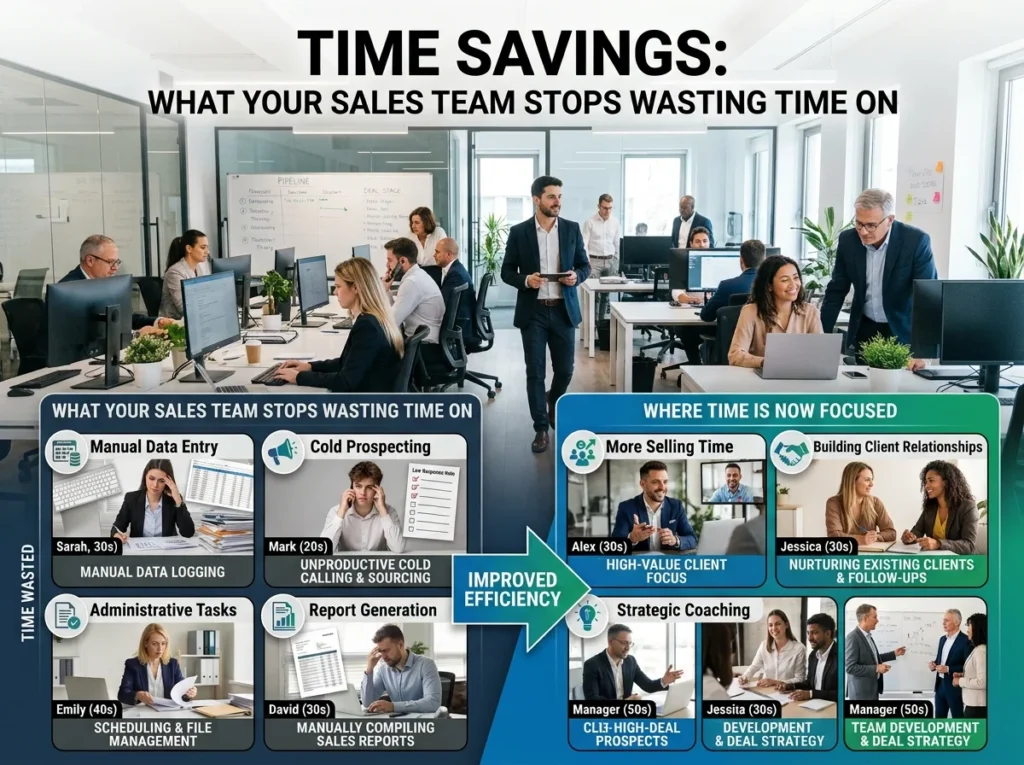
Time Savings: What Your Sales Team Stops Wasting Time On
Where Your Team Wastes Time Now
Salespeople spend too much time on admin. They enter data into spreadsheets manually. They copy information between systems constantly. They hunt for customer contact information. They manually track follow-up dates daily. They recreate emails they’ve already sent. This waste adds up to hours. Hours become days of wasted time. Time costs you real money always.
How CRM Eliminates Wasted Time
A CRM system eliminates this waste. Contacts get entered once and reused. Email integrations pull correspondence automatically. Follow-up reminders pop up automatically. Reports generate with just one click. Templates speed up common tasks. Sales reps get back hours weekly. That’s time to actually sell products. That’s time for deeper conversations. That’s time to find new opportunities.
Time Savings Add Up to Real Money
Hours saved multiply across your team. A ten-person team saves fifty hours. That’s equivalent to hiring one person. The ROI is obvious and quick. Your team closes more deals overall. They’re focused on selling, not admin. Revenue increases as a direct result. Profitability improves significantly across the board. Your business grows much faster now.
Choosing the Right CRM for Your Sales Team
Popular CRM Options to Consider
Salesforce is industry-leading but expensive. HubSpot is user-friendly and affordable. Pipedrive focuses specifically on sales teams. Zoho CRM offers good features affordably. Microsoft Dynamics serves large enterprises. Freshsales offers solid functionality overall. Each option has different strengths. Each has different weaknesses too. Some fit small businesses better. Some fit enterprises better overall.
How to Evaluate CRM Options
Consider cost first and foremost. Evaluate ease of use carefully. Check if features match your needs. Verify integration capability with other tools. Ensure it scales as you grow. Check customer support quality thoroughly. Verify data security and compliance. Look at customization options available. Check mobile access capabilities carefully. Review reporting features provided.
Steps to Choose Your CRM
Demo several options before deciding. Talk to current users about experience. Read honest reviews from real users. Consider implementation time and costs. Check training requirements thoroughly. Don’t pick the biggest or cheapest. Pick what works for your business. Get input from your sales team. The best CRM is what your team uses. Implementation success depends on adoption. Our experienced CRM provider team specializes in sales-focused implementations that maximize adoption and deliver measurable ROI for your sales organization.
FAQs About CRM Benefits for Sales Teams
1. What exactly is a CRM and what does it do?
A CRM is software that organizes customer data and tracks interactions automatically. It helps sales teams track leads, manage pipelines, forecast revenue, and close more deals consistently and effectively.
2. How much time can a CRM system really save?
Most teams save ten to fifteen hours weekly on administrative and data entry tasks. That’s equivalent to hiring one full-time employee dedicated only to paperwork instead of selling products.
3. Will implementing a CRM increase our sales revenue?
Yes, studies show sales teams increase revenue by twenty to thirty percent after implementing CRM properly. Improved organization, better lead tracking, and stronger follow-up drive better results consistently and measurably.
4. How long does CRM implementation take overall?
Small business implementation takes three to four months typically. Medium business takes four to six months. Enterprise implementation takes six to twelve months. Phased approaches take longer than concentrated efforts overall. Ready to boost your sales team’s productivity with the right CRM? Schedule your free sales CRM consultation and discover how we can help you close more deals.
5. What’s the best CRM for small sales teams?
HubSpot, Pipedrive, and Zoho offer great features for small teams affordably. They’re easy to use and don’t require extensive IT support to implement successfully and quickly.